 43
43

By hand & by heart
Michael's Cabinet Design
 Video
Video
He and his dad have been a staple on Youngstown’s Westside for decades. His father, also Mike, opened Mike’s Cabinet Shop in 1960 on Steel Street. After a few years and addresses, the business eventually settled into 1739 Mahoning Avenue, where it still exists today. It became young Mike’s in 1982 and eventually became Michael’s Cabinet Designs.
Business pressure leads to attack
A year ago, Mike Walkowiec was flush with orders for his cabinet business.
It was the right time to expand.
He and his dad have been a staple on Youngstown’s West Side for decades. His father — also named Mike — opened Mike’s Cabinet Shop in 1960 on Steel Street. After a few years and addresses, the business eventually settled into 1739 Mahoning Ave. It became young Mike’s shop in 1982, and he renamed it Michael’s Cabinet Designs.
But a tradition of quality craftsmanship that spanned a father, a son and five decades could not overcome the business reality of the city.
“People would call me and ask, ‘Now, where in Austintown are you?’” Mike said.
He would explain that he was “on Mahoning Avenue in Youngstown, not in Austintown.”
“Click. Never heard from them again,” Mike said.
It became a trend. He didn’t want to leave the West Side, but he knew that for survival, he needed to move the business and set his sites on a presence along U.S. Route 224.
Last February, with business stable, he signed a lease for space in Creekside Plaza just off Tippecanoe Road, where he expected to find his core client base for custom cabinets, mantels, entertainment centers, elaborate cases and more.
He opened that second store in May and was greeted by what he called “the worst stretch of business in 34 years.”
“I made this move, and the timing proved to be terrible.”
So? Close up shop and sit tight in the original space until the storm passes, right?
Denise Lockwood met Mike in October.
It was Oct. 8, to be exact. A Friday.
To be more specific, it was shortly after 7:15 a.m.
That preciseness is easy when it’s a life at stake and not simply a business.
On that day, at that moment, the pressure of Mike’s business gamble had finally gotten the best of him.
Denise was one of two paramedics who arrived at his Boardman home to see Mike in full cardiac arrest.
He had just watched the school bus take his kids to school at 7:10 a.m. when it struck.
Stabbing in the heart, profuse sweating and immense pressure on his chest.
Oddly enough, just days before, Mike received one of those mass e-mails sent from a friend of a friend that warned “This, too, can happen to you.”
The title? “Signs of a heart attack.”
With the e-mail fresh in his head, he grabbed the aspirin, the phone and unlocked the door — all tips in the e-mail.
“I told 911 to have the ambulance crew come right into the house.”
In four minutes, the fire department was there, and Denise was there a few minutes later.
“The desperation in his eyes was tremendous,” Denise said. “He was a classic case: pale white, shortness of breath, the weight of a person on his chest.”
He survived. The doc, Mike said, told him 50 percent of the folks with his attack don’t make it.
Mike’s mom did not make it.
She was 54 when she died 26 years ago of a heart attack.
Her age and cause of death have been like a slow ticking clock for Mike — counting off each of the last 26 years.
It got to Mike a year early. He was 53.
Denise, who went to visit Mike in the hospital a couple of days later, said the reward for her job is certainly not the money. It’s a tragedy what paramedics earn.
Her reward is life.
“I have the caring gene in me,” she said. “Mike’s still here, and his kids still have a dad. That’s the reward.”
But his business is still tough.
He has bids out for projects as high as $30,000 — but even folks with that kind of cash are not committing in this economy, he said.
His wife of 18 years, Crystal, has a good job, he said.
“She’s concerned but said the reality is we’ll never starve,” Mike said. Their kids are Delia, 10, and Zenin, 6.
So he waits through hard times, which like his craft, he was able to learn from his dad.
The elder Mike grew up in Ukraine and was working in the fields when the Nazis came through. As Mike tells it, the Nazis killed the family’s livestock for food. His dad’s mother and uncle resisted. (His father was traveling that day.)
The Nazis killed the mother and uncle. Mike’s dad, then 14, was taken to a concentration camp.
It was building camp barracks where Mike’s dad learned carpentry and woodworking.
After the war, he was sponsored by a church to come to the U.S., and eventually made it to Youngs-town — where he worked for the railroad at first, before eventually getting into homebuilding and then cabinetry and ultimately, Mike’s Cabinet Shop.
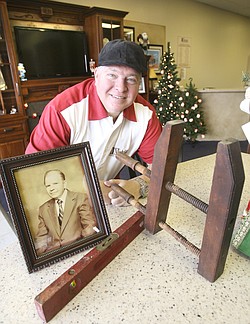
A portrait of the elder Mike and some of his tools sit prominently on one of his son’s handmade displays.
“Dad was tough. He lived a tough life, and I don’t think he could show [the love]. But he had it.”
Even after he retired from the business, Mike’s dad would stop by for an hour each day just to talk. That’s when their relationship was at its best, as were the life lessons for Mike to carry on.
“I just want to make sure, when I’m gone, that my kids remember I was a good father, and I loved them.”
Todd Franko is editor of The Vindicator. He likes e-mails about stories and our newspaper. E-mail him at tfranko@vindy.com He blogs, too, on vindy.com.