 43
43

Renowned Warren otologist offers advice to boomers
 Photo
Photo
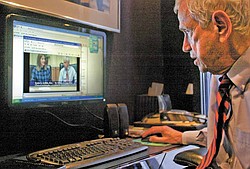
Dr. William H. Lippy, renowned ear doctor from Warren, looks over one of the videos heÕs made that deals with hearing loss and hearing aids. The doctor has five videos available online. The four- to five-minute programs are geared toward the layman and covers a variety of topics on hearing loss and hearing aids. To access the videos, go to www.lippygroup.com and click on hearing-aid videos.
HEARING AID VIDEOS
Fast facts
Warren otologist Dr. William H. Lippy, founder of The Lippy Group for Ear, Nose & Throat in Warren and an internationally known hearing restoration surgeon, has posted online a video series on hearing aids. Here are some facts concerning hearing loss:
31 million people in the United States have significant hearing loss.
60 percent of them are under 65.
15 percent of baby boomers, people born after World War II between 1944 to 1964, have hearing loss.
75 percent of people who need hearing aids are not wearing them.
Source: Dr. William H. Lippy
By WILLIAM K. ALCORN
alcorn@vindy.com
WARREN
Hey baby boomers, listen up. That is, if you can still hear.
Do you find yourself saying more and more often, “What did you say?” or turning your “good ear” toward the speaker?
When you ask when dinner will be ready, does your spouse have to respond several times, finally shouting the answer before you understand?
Does the dialogue of a television show sometimes elude you?
If so, a hearing aid may be your — and your family’s salvation —said Warren otologist Dr. William H. Lippy, founder of The Lippy Group for Ear, Nose & Throat in Warren and an internationally known hearing restoration surgeon.
Thirty-one million people in the United States have significant hearing loss, 60 percent of them under 65. Of the so-called baby boomers, people born between 1944 and 1964, 15 percent have hearing loss, Dr. Lippy said.
The primary causes of hearing loss are the aging process and loud noise. In the Mahoning Valley, a tremendous number of men who worked in steel mills and served in the military have significant hearing loss.
Some hearing problems result from disease and infection, but genetics plays a very small part, Dr. Lippy said.
Musicians who play amplified music and people who work with power tools, such as chain saws, snow blowers and riding mowers, are at particular risk for high-frequency losses, he said.
Hearing well is not just a convenience. It can be a matter of personal safety and quality of life. It can lead to depression and withdrawal, tension in families, and loss of earning power, he said.
The broad problems are that people don’t know a lot about modern, technically advanced hearing aids, and much of the information out there is not very accurate, he said.
To address those problems, Dr. Lippy has developed an online series of five videos that shed light on a variety of hearing-aid issues and subjects.
The four- to five-minute videos are geared toward the layman and cover these topics: “Are You a Candidate for Hearing Aids?” “Hearing Aids Basics,” “Benefits of Hearing Aids,” “Will You Be Satisfied With Hearing Aids?” and “Buying Hearing Aids.” There also is a video about “Operative Options.”
To access the videos, go to www.lippygroup.com and click on hearing-aid videos.
Dr. Lippy, a graduate of Niles McKinley High School and Ohio State University’s School of Medicine, has performed more than 18,000 stapedectomies — surgeries to improve hearing — including more than 2,000 revisions, or fixes, that corrects otosclerosis, a progressive disease caused by a problem with the third little bone in the ear, called the stapes or stirrup bone.
The operation, done under local anesthesia through an operating microscope under high magnification, removes the stapes bone and replaces it with a tissue graft and a titanium prosthesis.
Over his more than 50-year career, Dr. Lippy has created “The Lippy Stapes Prosthesis,” and many instruments used in stapedectomy surgery. He has published some 60 peer-review papers and a dozen book chapters, and also teaches and performs ear surgery abroad.
In 2008, Dr. Lippy, past president of the Otosclerosis Study Group, developed and posted online an e-library of 24 videos to be used as a training tool for other physicians.
At the time, Dr. Lippy called the e-library, a project of his nonprofit organization the Warren Hearing Foundation, “the culmination of his life’s work.” Physicians from 74 countries have visited the e-library at www.TheLippyLibrary.com for an average 42 minutes each.
The response was “beyond our wildest dreams,” said Dr. Lippy, who credited the e-library project with having a lot to do with his receiving the American Otological Society’s 2009 “Award of Merit,” presented to one person a year.
The e-video library and the hearing-aid series were produced by DKW Multimedia in Columbus. Dr. Lippy’s son, David W., was executive producer of the projects.
“We decided to create this video series and post it online because one in four of our adult population is a candidate to be helped with proper fitting hearing aids,” Dr. Lippy said.
In addition to the hearing-aid video series, John Burkey, chief audiologist at the Lippy Group, has written a book, “Baby-Boomers and Hearing Loss: A Guide to Prevention and Care.”
The biggest problem with hearing aids is that the majority of people who could benefit never try them, Burkey said.
“Seventy-five percent of people who need hearing aids are not wearing them; yet once we fit a patient with a hearing aid, 93 percent are very satisfied,” Dr. Lippy said.