 43
43

School drug program commands attention
 Photo
Photo
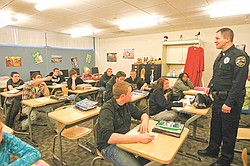
Ryan Williams, Canfield Police Department's school resource officer at the Mahoning County Career and Technical Center, talks with students in Donna Greer's English class Thursday morning. Canfield police partnered with MCCTC and Canfield High School to implement a new drug training program geared toward young adults..
By Elise Franco
Canfield
A new spin on drug training at Canfield High School has successfully engaged students in conversation about adult decision-making and consequences.
The Drug Use Prevention and Education Program was developed by officers in the city’s police department, and in its first years has caught and kept the attention of its target audience: students.
Senior Joey DeLisio, 18, said a lot of in-school drug or alcohol programs tend to preach, not inform.
DeLisio said she and her classmates were treated as adults and given information about drugs and alcohol, their effects and the consequences a young adult faces by using.
“When you come to high school from junior high, everything is different; you’re not as sheltered,” she said. “The officers talked to us like grown-ups. They didn’t sugar coat anything.”
DeLisio said that approach seemed to make all the difference to everyone, even classmates who may have been skeptical at first.
“They discussed Fourth Amendment rights and the consequences someone who is 18 faces as opposed to a minor,” she said.
Scott Weamer, Canfield assistant police chief, said the program was developed to help older students make informed decisions.
It was funded through two grants — each for about $3,000 through the Ohio attorney general and the local Drug Education Officers group, Weamer said.
He said each grade — eight through 10 and 12 — goes through a specific, age-appropriate program.
Students in grades 11 and 12 at the Mahoning County Career and Technical Center also go through the program.
“It goes beyond what is taught through D.A.R.E in grades five and seven ... Students should continue to be educated [about drugs and alcohol,]” he said. “By the time kids get to high school they’re young adults, not children.”
The eighth-grade lessons are made up of common concerns, such as how drugs and alcohol can affect one’s ability to deal with issues, as well as consequences of abuse, Weamer said.
Freshmen lessons mostly are about making the transition to high school and social concerns, such as peer pressure and self-esteem. Weamer said freshmen also begin to learn about the legal side of underage and illegal use.
In 10th grade, which Weamer said is the bulk of the program, students learn about abuse and addiction, specific drugs such as marijuana, prescriptions and street drugs as well as treatment options.
Officers teach seniors about constitutional issues — search and seizure, Miranda rights and the difference between the juvenile and adult justice systems.
Weamer said the goal is to provide students with as much information as possible.
“We know they’re going to make their own decisions no matter what we say,” he said.
Superintendent Dante Zambrini said the program is also a way for the school district to collaborate with the police department.
“It’s a situation where we’re all trying to provide tools for good decision-making for our students,” he said. “We feel these are lifelong skills they’re learning. It allows the student to question their personal responsibility, to themselves and to others.”
Zambrini said because the program is in its infancy there isn’t statistical data to determine exactly how effective it is, but he thinks it’s working.
“Any program that helps students and parents be better aware and have a better understanding is worthwhile,” he said. “This is a fresh new approach.”
DeLisio said she was surprised at the number of classmates who engaged in conversation during and after the training.
“Everyone was into the conversation and asking questions,” she said. “Everyone, in my grade at least, gave it a shot and gave the officers their attention and respect.”
Weamer said he also was impressed with students in every grade level.
“We’re not there to preach to them,” he said. “And they’ve all been really receptive to that. They’re interacting during and giving feedback after.”