 43
43

Shooting suspect had met Giffords

 Photo
Photo
ASSOCIATED PRESS
This March 2010 photo shows a man identified as Jared L. Loughner at the 2010 Tucson Festival of Books in Tucson, Ariz. The Arizona Daily Star, a festival sponsor, confirmed from their records that the subject's address matches one under investigation by police after a shooting in Tucson that left U.S. Rep. Gabrielle Giffords wounded and at least five others dead. Police say a suspect is in custody, and he was identified by people familiar with the investigation as Jared Loughner, 22, of Tucson.
 Photo
Photo
ASSOCIATED PRESS
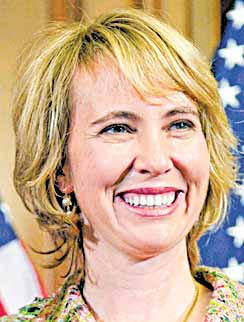
In this photo taken Wednesday, Jan. 5, 2011, Rep. Gabrielle Giffords, D-Ariz., takes part in a reenactment of her swearing-in, on Capitol Hill in Washington. Rep. Gabrielle Giffords of Arizona was shot in the head Saturday, Jan. 8, 2011 when an assailant opened fire outside a grocery store during a meeting with constituents, killing at least five people and wounding several others in a rampage that rattled the nation.
Doctors stay optimistic about US rep’s recovery
Associated Press
TUCSON, Ariz.
At an event roughly three years ago, U.S. Rep. Gabrielle Giffords took a question from Jared Loughner, the man accused of trying to assassinate her and killing six other people. According to two of his high school friends the question was essentially this: “What is government if words have no meaning?”
Loughner was angry about her response — she read the question and had nothing to say.
“He did not like government officials, how they spoke. Like they were just trying to cover up some conspiracy,” one friend told The Associated Press on Sunday.
Both friends spoke on condition of anonymity, saying they wanted to avoid the publicity surrounding the case. To them, the question was classic Jared: confrontational, nonlinear and obsessed with how words create reality.
The friends’ comments paint a picture bolstered by other former classmates and Loughner’s own Internet postings: that of a social outcast with nihilistic, almost indecipherable beliefs steeped in mistrust and paranoia.
“If you call me a terrorist, then the argument to call me a terrorist is Ad hominem,” the 22-year-old wrote Dec. 15, part of a wide-ranging screed that was posted in video form and ended with this: “What’s government if words don’t have meaning?”
On Sunday, Loughner was charged with the shootings a day earlier at a political event outside a Tucson supermarket. Aside from the six killed, 14 people were wounded. Doctors were optimistic about Giffords’ chances for survival.
Loughner had at least one other contact with Giffords. Investigators said they carried out a search warrant at Loughner’s home and seized a letter addressed to him from Giffords’ congressional stationery in which she thanked him for attending a “Congress on your Corner” event at a mall in Tucson in 2007 — the same kind of event where officials say Loughner opened fire Saturday.
Other evidence seized from his home included an envelope from a safe with messages such as “I planned ahead,” “My assassination” and the name “Giffords” next to what appears to be Loughner’s signature.
His high school friends said they fell out of touch with Loughner and last spoke to him around March, when one of them was going to set up some bottles in the desert for target practice and Loughner suggested he might come along. It was unusual — Loughner hadn’t expressed an interest in guns before — and his increasingly confrontational behavior was pushing them apart. He would send nonsensical text messages, but also break off contact for weeks on end.
“We just started getting sketched out about him,” the friend said. It was the first time he’d felt that way.
Around the same time, Loughner’s behavior also began to worry officials at Pima Community College, where Loughner began attending classes in 2005, the school said in a release.
Between February and September, Loughner “had five contacts with PCC police for classroom and library disruptions,” the statement said. He was suspended in September 2010 after college police discovered a YouTube video in which Loughner claimed the college was illegal according to the U.S. Constitution.
He withdrew voluntarily the following month, and was told he could return only if he met certain conditions, including getting a mental health professional to agree that his presence on campus did not present a danger, the school said.