 43
43

A place for many to call home
The Vindicator (Youngstown)
 Photo
Photo
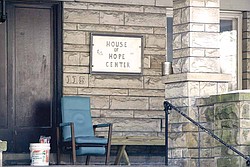
The House of Hope, 115 Illinois Ave., Youngstown.
By Dan Pompili
TheNewsOutlet.org
YOUNGSTOWN
It’s a struggle with House of Hope, as various records and officials indicate.
For many, however, life would be a struggle without Hope as well.
Lt. John Kelty of the city’s police department said that without places such as Hope, the residents would be on the streets.
In 2010, 13,983 Mahon-ing County residents received 163,518 hours of mental-health services.
The 1999 closing of the Woodside State Psychiatric Hospital in Youngs-town released numerous patients onto the streets with no other means of care.
Though Hope — the former Bryson Manor at 115 Illinois Ave. on the city’s North Side — may not be the ideal place, it is better than no place, Kelty said. Hope, which opened in 1993 as Bryson, was acquired by its former administrator and two others in January 2010.
“I’d rather have 10 Bryson Manors than zero Bryson Manors,” Kelty said. “My job is to protect the citizens of Youngstown, and [mental-health patients] being in places like [House of Hope] makes my job easier.”
James J. Leo, a Galena, Ohio, attorney representing the House of Hope, said in a letter to The Vindicator last week that “it is critical to note that the residents of House of Hope are there on a voluntary basis.”
“They are not compelled to stay and may leave, at any time, if they desire,” Leo wrote. “They have decided to make House of Hope their home.”
But options for those who choose to live in a group home are dwindling. At least five group homes in the Youngstown area have closed in recent memory, two in the last year, said William Carbonell, director of clinical programs and evaluations at the Mahoning County Mental Health Board.
Tom Arens, executive director of the Doris Burdman Home on Broadway on the North Side, said closing facilities such as group homes usually has the effect of leaving some residents uncared for.
Many mental-health patients who now live in group homes such as House of Hope used to reside at Woodside or were homeless.
“It’s a big hole in what we have, and I don’t know how to fill it,” Kelty said.
Eight homes are currently operating, including House of Hope.
For Hope, the tragic deaths or sexual offenses are not the most-exhausting violations that threaten its operations. The biggest threat has been from Ohio Department of Health violations, to which new owners have responded most aggressively.
Inspections and corrections
According to the State of Ohio Long-Term Care Consumer Guide — a website that lists various long-term care facilities, their ratings, state inspection reports and citations — the facility has been cited for at least 39 violations since February 2007.
The most recently published Ohio Department of Health inspection report, from Sept. 21, 2010, is 113 pages and cites numerous violations; many of them repeated from previous inspections.
According to inspection reports from February 2007 to September 2010, the facility was cited for having “failed to maintain a clean and sanitary kitchen and dining area” and failure “to ensure all bathrooms were maintained in good repair and in a clean and sanitary manner.”
Most notably, the bathrooms were cited for dirty floors, sinks and toilets; rusted and broken fixtures; little or no water pressure; and excessive or substandard water temperatures.
The Area Agency on Aging 11 provided The Vindicator with photos the agency shot Nov. 30 and Dec. 15 showing broken, clogged, unclean fixtures in the bathroom areas. The photos were taken to augment the state’s monitoring of the facility.
Leo, the attorney representing House of Hope, in a letter to The Vindicator warned “the photos may not be representative of current conditions” while declining the newspaper’s request to take new photos of the facility.
The inspection reports cited House of Hope for kitchen surfaces and floors that were noted to be black and sticky, food-storage methods were unsanitary, and hand-washing facilities were unsanitary and inadequate.
Foods were served without proper temperature checks. Some breakfast trays with milk and orange juice were left out at room temperature for as many as three hours before being served.
In other cases, the kitchen staff did not keep nutritional and dietary logs, or menu plans, including ones for diabetic residents.
In the residents’ rooms, temperatures were below acceptable levels, emergency call buttons were either not available in the bathrooms or were found nonfunctioning, and mattresses occupied by incontinent residents had no plastic or rubber protectors.
According to the June 8 inspection report, the facility failed to conduct recommended testing for tuberculosis on newly admitted residents and annual tests on current residents and staff.
Hope administrators Charlene Crissman and Lisa Lloyd said they have worked to improve the facility since taking over ownership and have made multiple improvements, including:
•Replacing the resident-call system.
•Installing a security system and cameras that allow them to monitor the facility from their homes while off duty.
•Re-tiling, re-carpeting and painting the main living area and resident rooms.
•Implementing regular fire and tornado drills and updating the fire system.
•Wrapping all mattresses with fire-retardant plastic covers.
They also have added new chairs and tables and decor to the dining room to make it more comfortable.
Crissman added that owner-administrator Michael Binder is working with grant writers to obtain funding for new windows and a new roof.
She also said that since Lloyd took over as director of care in 2010, the facility has received no medical violations.
Client care concern
Another cited failure on Bryson’s part is the inadequacy or absence of transfer arrangements to skilled-care facilities in the event that a resident requires emergency medical attention.
This failure may have contributed to Robin Courtright’s death in November 2007. On Nov. 10, an ambulance responded, finding 47-year-old Courtright dead in his bed. Courtright was suffering from chronic obstructive pulmonary disease (COPD), hypertension and paranoid schizophrenia.
According to the police report, Bryson could not provide him with supplemental oxygen to treat his COPD, and they were unable to arrange transfer to a skilled-care facility.
Crissman said she had a conversation with Robin Courtright and his caseworker in which he stated that he did not want “to have an oxygen tank on my back for the rest of my life.”
She said he was aware of his condition and competent to make his own decision to decline nursing care.
Alan Courtright, Robin’s brother, however, said, “If he was competent to care for himself, he would not have been there.”
More than a year later, Bryson was cited during the Nov. 24-25, 2008, inspection for failure to maintain a written transfer agreement “with another facility to meet the needs of the residents, should the need arise.”
Avoiding closure
The Ohio Department of Health’s highest officials eventually weighed in on Bryson in August 2008 when department director Dr. Alvin D. Jackson sent Bryson notice that its license was to be revoked.
The decision was based upon the multiple inspection findings in 2008. Bryson requested an appeal, and the Ohio Department of Health scheduled an administrative hearing for February 2009.
An examiner upheld the health department’s order, only to have that decision reversed in Mahoning County Common Pleas Court by Magistrate Timothy Welsh.
He ruled that due process was denied for Bryson because the state presented to the examiner parts of its inspection findings from all of 2008 even though it told Bryson it would only present November 2008 inspection results.
Bryson was allowed to remain open. Welsh has not returned calls seeking comment.
Officials at the state health department said a Dec. 6 deadline was not a hard date, after which they would close the facility. Crissman said that they planned to petition the state to allow them more time to make corrections and improve the facility.
Officials said that closing the home is always a last resort.
If House of Hope continues to consistently fail inspections, however, ODH will make a referral to the Center for Medicaid Services, which may then pull Residential State Supplement funding from the home, essentially rendering House of Hope financially defunct.
Hope for Hope
Kelty and others agree that places such as Hope are intended to fill a crucial community need.
Although House of Hope is monitored and inspected by the ODH, its administrators are quick to point out the group home is not a state mental institution and it does not have the same resources.
For instance, House of Hope does not have the same means of reimbursement through Medicaid, Saulitis said, though the facility could apply for the Assisted Living Waiver Program that would yield more income per resident if House of Hope qualifies. Saulitis said places such as House of Hope rely on the residents’ “room and board” payments as income, unlike nursing homes that receive payment through Medicare or Medicaid.
“I think they’re doing the best they can with what they have,” Kelty said.
Alvin Weisberg, director of Jewish Family Services of Youngstown, is a caseworker who has had clients at Hope.
He said that part of the problem with places such as Hope is a lack of funding for more agreeable alternatives. While Weisberg said that Hope’s problems should by no means be ignored, he also indicts the state and local public health system.
“The problem is that you don’t have competition from other providers,” he said, suggesting more facilities with high standards would improve conditions overall.
Though Issue 2, the mental-health renewal levy, recently passed and will assist the county bureaus that deal with mentally disabled services, House of Hope will receive none of that money.
House of Hope receives federal funding in the form of Supplemental Security Income payments and Residential State Supplements to house their residents.
Some residents may pay only $500 per month because that is all their disability check is worth, although the home officially charges $877 per month to live there. Lloyd and Crissman said the residents do not pay their whole disability check either. They receive allowances of about $70 per month for spending money.
Lloyd said they have petitioned the city for aid but have been refused and made to feel that they and their residents are not a priority.
They said they have at times watched their employees collect a paycheck while administration received no compensation for their work. Crissman and Lloyd said times are not so lean now, but they continue to pay out of pocket for improvements to the home.
For now, Weisberg offered a cautiously optimistic perspective on the future of House of Hope.
“If it is a house of hope, then we would hope some things would improve,” he said. “But how long is a reasonable amount of time to assess if it is, in fact, a new day?”
The NewsOutlet is a joint media venture by student and professional journalists and is a collaboration of Youngstown State University, WYSU radio and The Vindicator.