 43
43

Razing of home at YSU averted
The Vindicator (Youngstown)
 Photo
Photo
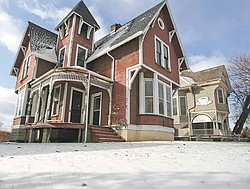
The Thompson/Sacherman House on Lincoln Avenue on the Youngstown State University campus was slated for demolition but has been given a stay to allow a committee comprised of university and community members to research possible alternatives.
Panel to study options for historic Lincoln Ave. place
By Denise Dick
YOUNGSTOWN
A historic house on the Youngstown State University campus got a reprieve from the wrecking ball — at least for now.
YSU trustees voted last month to demolish the Thompson/ Sacherman House on Lincoln Avenue, citing its deteriorated condition, the cost to repair/renovate it and a lack of an identified educational use for it.
The Peck House on Wick Avenue also had been recommended for demolition by the university administration, but trustees took no action on that proposal.
Members of the Mahoning Valley Historical Society and Youngstown CityScape and other individuals wrote a letter to YSU President Cynthia E. Anderson and trustees.
“We wanted to express other potential alternatives to” demolishing the buildings, said William Lawson, executive director of the historical society. “If we give ourselves the time and bring the right people together, there may be opportunities either for the university or for a university-private partnership.”
Lawson and Sharon Letson, executive director of Youngstown CityScape, met this week with university representatives to voice their concerns.
“From that meeting, what they have agreed to do is to hang on and to not bring anything down,” Letson said. “We’re putting together a committee.”
The committee will include university representatives, an architect, Lawson, Letson and other community members.
“The first we’ll do is a tour of those two buildings, and we also want to tour Pilgrim Collegiate Church,” she said. The church on Wick across from Jones Hall also is owned by the university.
“We’re also involved somewhat with the National Preservation Trust to begin to help the university in how we reuse these buildings or some plan,” Letson said.
She expects the tours to be scheduled soon.
Lawson said that all three structures represent significant architects from the community.
“The two houses are both from the 1880s when the lower North Side neighborhood was really taking off,” he said. “They represent the growing wealth and influence we had in Youngstown and the surrounding areas because of the iron industry and then later, steel.”
Gene Grilli, YSU’s vice president of finance and administration, said “the university feels we can work together and put together a committee to study” the buildings.
“We had a nice discussion and set the framework for moving ahead,” Grilli said.
Letson said the idea is to try to come up with some reuse ideas.
“In particular, Wick Avenue is historically very, very important,” she said. “We feel the pain of the university. We understand their budget cuts.”
Letson said the community is a stakeholder, too.
“We want to share the burden, share our resources,” she said. “We may not have money, but we may have some expertise that may help that we may be able to share. While I believe they’ve tried their best from their end, we’re asking them to try with a more-involved community.”
Lawson said the city has lost many historic homes in recent years. The Rice Thomas House formerly housed the Dana School of Music. It was torn down in the early 1980s. The Fame Conservatory, north of the Melnick House on campus, was demolished in the late 1990s.
The large, stone colonial Myron Arms House fell to the wrecking ball in the 1970s.
“We lost a lot of homes when the Madison Avenue Expressway came through on Wick and the surrounding streets immediately around there,” Lawson said.