 43
43

Picking up the pace: Canfield schools warm up to Race to the Top

The Vindicator (Youngstown)
 Photo
Photo
Michael Kerensky, Canfield Village Middle School teacher and supporter of the Race to the Top initiative, walks the hallways with students as he helps ready the school, teachers and administrators for the new program.
The Vindicator (Youngstown)
Photo
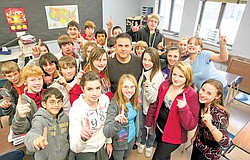
Michael Kerensky, Canfield Village Middle School teacher, stands with his seventh grade history class. The Race to the Top grant will help the school improve even with its Excellent rating from the Ohio Department of Education.
By Kristine Gill
CANFIELD
Teachers union President Cheryl McGrath admits she’s probably not the most-popular person in Canfield schools these days.
“Until we educate everyone, there’s fear,” she said of the federal nationwide effort to reform public schools. “It’s a slow process, but we’re coming along.”
When it began, Race to the Top put educators on edge who thought the primary goal of the program was to link student test scores to teacher evaluations and even their pay. Like many districts, Canfield administrators weren’t keen on signing up with the four-year program. But the district applied for the grant once administrators were savvy to the details and the reality: Even if they didn’t take part, they’d eventually have to adopt the principles the project established.
The $25,000 the district receives through the grant each year will be used to send teachers to training conferences and to cover the cost of substitutes in those cases, McGrath said.
“We have a voice in how this will look for us now,” said Jo Taylor, a Canfield Village Middle School principal and member of the transformation team overseeing the project. “Other schools will have to tailor it to their needs.”
The state also asked for districts to commit to the plan rather quickly, giving only a short window for applications.
“It was like a high-pressure sales pitch: Buy now and we’ll do this; if not, you’ll never get this price again,” said Michael Kerensky, seventh-grade history teacher and teachers union executive board member.
Kerensky voted against applying for the grant in the first round of applications and in the second for the same reason. Knowing what he knows now, he said he would have voted yes from the beginning.
“There are still a lot of teachers that are not happy about it, but mostly the ones who aren’t happy about it haven’t really taken time to examine it,” Kerensky said.
Canfield Superintendent Dante Zambrini said some apprehension comes from the expectation that teachers are responsible for how students perform in state standardized tests that are evolving and don’t align with teaching methods.
“I can’t hold you responsible for making an apple pie if I only gave you oranges,” Zambrini said. “Accountability is not a bad word. It’s just the idea that some people feel, ‘How can we be held accountable when test standards are changing?’”
Taylor admits the prospect of sweeping change is a daunting one but something the district would face regardless of its participation in the grant considering the failure of a new levy last November.
“We are supposed to dramatically transform what we do — not just polish an apple. It’s very scary. This shouldn’t fit into what we already do,” she said. “In this district, we’re looking at change no matter what with our finances, so maybe we swallow it as one bitter pill.”
An executive board comprised of Taylor, Zambrini, a third administrator and nine teachers has been meeting monthly since November to lay out the tasks ahead in the first year of the four-year grant. Taylor said they’ll likely begin meeting twice a month considering the amount of work ahead. Newly formed subcommittees will begin tackling some of the 32 tasks outlined for 2011.
Taylor and McGrath already have met with middle- and high-school teachers to answer questions. They’ll meet with elementary-school staff next week.
Those they’ve already met with are warming to the idea.
“Teachers are critical to the success of it,” Taylor said. “If they’re not on board or aware, we’re toast; we’re wasting our time.”
Dispelling myths about value-added scores has brought the most relief. Taylor said those scores already are part of a teachers’ annual report card. They measure how much overall progress a class has made based on the difference between expected and actual growth. Race to the Top proposes that they carry more weight in a teacher’s evaluation, but they won’t be sole indicators of his or her performance.
McGrath said many teachers worry the measure is unfair considering some students are more difficult to teach. But as difficult as it may be to improve teaching tactics, Taylor said it’s for the benefit of students.
“That’s what we’re here for,” she said. “We’re not here to rest on our laurels and pretend-teach.”
Taylor said education traditionally has used a top-down communication system where administrators make decisions and teachers are told to follow them. Race to the Top includes teachers in the conversation and fosters change in the opposite direction.
“I’ll be honest — it’s awkward,” McGrath said. “I’m telling my boss what to do.”