 43
43

Pa. allows dumping of water
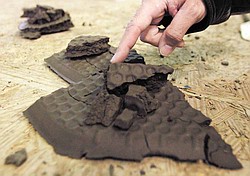
ASSOCIATED PRESS
 Photo
Photo
In this photo made on Dec. 15, 2010, Jim Riggio, the plant manager for the Beaver Falls Municipal Authority, shows a sample of the solid materials removed from the Beaver River water during treatment at the Beaver Falls Municipal Authority plant in Beaver Falls, Pa. The natural gas boom gripping parts of the U.S. has a nasty byproduct: wastewater so salty, and so polluted with metals like barium and strontium, most states require drillers to get rid of the stuff by injecting it down shafts thousands of feet deep. Not in Pennsylvania, one of the states at the center of the gas rush. There, the liquid that gushes from gas wells is only partially treated for substances that could be environmentally harmful, then dumped into rivers and streams from which communities get their drinking water.
Associated Press
The natural-gas boom gripping parts of the U.S. has a nasty byproduct: wastewater so salty and so polluted with metals such as barium and strontium that most states require drillers to get rid of the stuff by injecting it down shafts thousands of feet deep.
Not in Pennsylvania, one of the states at the center of the gas rush.
There, the liquid that gushes from gas wells is only partially treated for substances that could be environmentally harmful, then dumped into rivers and streams from which communities get their drinking water.
In the two years since the frenzy of activity began in the vast underground rock formation known as the Marcellus Shale, Pennsylvania has been the only state allowing waterways to serve as the primary disposal place for the huge amounts of wastewater produced by a drilling technique called hydraulic fracturing, or fracking.
State regulators, initially caught flat-footed, tightened the rules in 2010 for any new water treatment plants but allowed any existing operations to continue discharging water into rivers.
At least 3.6 million barrels of the waste were sent to treatment plants that empty into rivers during the 12 months ending June 30, according to state records. That is enough to cover a square mile with more than 81/2 inches of brine.
Researchers still are trying to figure out whether Pennsylvania’s river discharges, at current levels, are dangerous to humans or wildlife. Several studies are under way, some under the auspices of the Environmental Protection Agency.
State officials, energy companies and the operators of treatment plants insist that with the right safeguards in place, the practice poses little or no risk to the environment or to the hundreds of thousands of people who rely on those rivers for drinking water.
But an Associated Press review found that Pennsylvania’s efforts to minimize, control and track wastewater discharges from the Marcellus Shale have sometimes failed.
For example:
Of the roughly 6 million barrels of well-liquids produced in a 12-month period examined by the AP, the state couldn’t account for the disposal method for 1.28 million barrels, about a fifth of the total, because of a weakness in its reporting system and incomplete filings by some energy companies.
Some public water utilities that sit downstream from big gas wastewater plants have struggled to stay under the federal maximum for contaminants known as trihalomethanes, which can cause cancer if swallowed over a long period.
Regulations that should have kept drilling wastewater out of the important Delaware River Basin, the water supply for 15 million people in four states, were circumvented for many months.
In 2009 and part of 2010, energy company Cabot Oil & Gas trucked more than 44,000 barrels of well wastewater to a treatment facility in Hatfield Township, a Philadelphia suburb. Those liquids ultimately were discharged into a creek that provides drinking water to 17 municipalities with more than 300,000 residents. Cabot acknowledged it should not have happened.
People in those communities had been told repeatedly that the watershed was free of gas waste.
The situation in Pennsylvania is being watched carefully by regulators in other states, some of which have begun allowing some river discharges. New York also sits over the Marcellus Shale, but Gov. David Paterson has slapped a moratorium on high-volume fracking while environmental regulations are drafted.
Industry representatives insist that the wastewater from fracking has not caused serious harm anywhere in Pennsylvania, in part because it is safely diluted in the state’s big rivers. But most of the largest drillers say they are taking action and abolishing river discharges anyway.
Cabot, which produced nearly 370,000 barrels of waste in the period examined by the AP, said that since the spring it has been reusing 100 percent of its well-water in new drilling operations, rather than trucking it to treatment plants.
“Cabot wants to ensure that everything we are doing is environmentally sound,” said spokesman George Stark. “It makes environmental sense and economic sense to do it.”
All 10 of the biggest drillers in the state say they either have eliminated river discharges in the past few months or reduced them to a small fraction of what they were a year ago. Together, those companies accounted for 80 percent of the wastewater produced in the state.
The biggest driller, Atlas Resources, which produced nearly 2.3 million barrels of wastewater in the review period, said it now is recycling all water produced by wells in their first 30 days of operation, when the flowback is heaviest.