 43
43

Service examines Emancipation Proclamation
The Vindicator (Youngstown)
 Photo
Photo
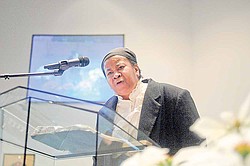
The Rev. Monica Beasley-Martin of Sheridan A.M.E. Church, East Liverpool, participates in the Emancipation Proclamation and Installation service at New Bethel Baptist Church, Youngstown. She performed a skit Saturday as black abolitionist Harriet Tubman.
The Vindicator (Youngstown)
Photo
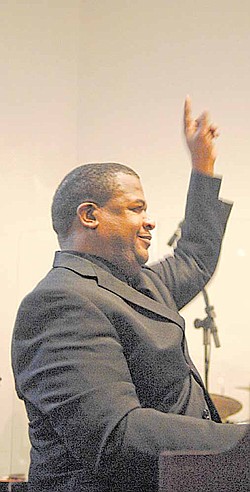
Luke Shumpert, minister of music at Elizabeth Baptist Church and director of the Emancipation Community Choir, directs the music Saturday morning during the Emancipation Proclamation and Installation Service at New Bethel Baptist Church.
EMANCIPATION PROCLAMATION
Key declarations
The historic document signed by President Abraham Lincoln that took effect Jan. 1, 1863, was the main subject of a 21⁄2-hour program Saturday at New Bethel Baptist Church on Youngstown’s South Side. Some facts about the document:
The Emancipation Proclamation allowed black men, many of them freed slaves, into the Union Navy and Army.
Toward the end of the Civil War, close to 200,000 black sailors and soldiers had fought for the Union.
While allowing slaves in rebellious states to be free, it exempted parts of the Confederacy already under Northern control.
It strengthened the Union militarily and politically while adding moral force to its cause.
The five-page document is in the National Archives in Washington, D.C.
Source: National Archives and Records Administration
By Sean Barron
YOUNGSTOWN
If you assume President Abraham Lincoln’s signing of the Emancipation Proclamation meant freedom for nearly all slaves, you might consider holding the historic document to closer scrutiny, a pastor and community activist says.
In truth, the 19th- century document applied only to slaves in those states that had seceded from the Union, and left slavery largely untouched in other states, the Rev. Dr. David B. Thornton contends.
“It weakened states rebelling against the Union; others could continue with slavery,“ he said during Saturday’s Emancipation Proclamation and Installation Service at New Bethel Baptist Church, 1507 Hillman St., on the city’s South Side.
Sponsoring the two-hour program were the Interdenominational Ministerial Alliance and the Baptist Pastor’s Council, both of Youngstown.
During his presentation, “Liberate the Soul by Freeing the Mind,“ the Rev. Mr. Thornton, pastor of Grace Memorial Presbyterian Church in Pittsburgh, noted that the document allowed many black men to join the Union Army and Navy during the Civil War.
Many freed slaves were entering a segregated military and suddenly becoming liberators, he told an audience of more than 100.
Saturday’s presentation also marked the 148th anniversary of the Emancipation Proclamation’s taking effect Jan. 1, 1863.
Mr. Thornton recalled having examined the original document online and concluded that Lincoln had signed it largely as a war measure. In addition, he said, the Emancipation Proclamation was mainly a political move that strengthened the Union military’s size and power.
Lincoln “was more concerned about preserving the Union,” Mr. Thornton said, adding that the more he studied the document, the more he realized it also was a step toward freedom for many.
Nevertheless, even though the document represented liberation and freedom for many slaves, modern forms of slavery continue nearly 150 years later, he continued.
Mr. Thornton cited people’s being in debt, as well as passion for consumerism and materialism as examples, saying that the latter causes many people to compromise their values and morals. It also runs contrary to the spirit and meaning of Christmas, he added.
Some of those who spend beyond their means during the holiday still pay for it years later, Mr Thornton said.
The true way to liberate people’s souls and free their minds is by following the example of Jesus Christ and adhering to God’s ways while resisting compliance with the status quo, the pastor explained. To that end, he cited Romans 12:2, which reads in part: “And be not conformed to this world: but be ye transformed by the renewing of your mind.”
“We need a checkup from the neck up on this first day of 2011,” Mr. Thornton added.
Also speaking was the Rev. Lewis W. Macklin II, pastor of Holy Trinity Missionary Baptist Church in Youngstown, who said that faith is a powerful tool for many people to move forward and accomplish great things.
Saturday’s program also coincided with Imani (faith), the seventh and final day of Kwanzaa, where people are asked to believe in the greater good of work they do for one another and their community, the Rev. Mr. Macklin pointed out.
Other remarks were from the Rev. Lonnie K. A. Simon, New Bethel’s pastor emeritus, who received the Rev. Elizabeth Powell Heritage Award for his longtime contributions, sacrifices and leadership for the community. His son, the Rev. Kenneth L. Simon, is New Bethel’s pastor.
Musical selections and entertainment were from the Emancipation Community Choir and the Harambee Drummers.