 43
43

Students learn how robots tick
 Photo
Photo
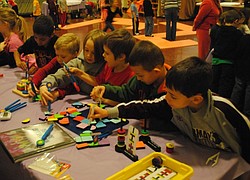
Neighbors | Shaiyla Hakeem .No hands were allowed at the station "Robot Remotely." Students stacked blocks using only plastic grips which simulated a robot's hand.
 Photo
Photo
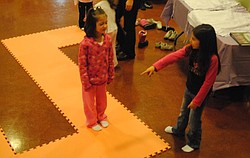
Neighbors | Shaiyla Hakeem .West Elementary's Danielle Flynn (left) held her eyes closed as Riley Adams directed where to walk. Since robots rely on sensors, students practiced maneuvering through a path relying on the help of their peers.
 Photo
Photo
Neighbors | Shaiyla Hakeem .First-graders Brandon Swader (left), Ethan Dunkel and Dominic Vennetti built a circuit Dec. 3 by snapping the correct pieces in place. They learned that robots use electricity to function.
 Photo
Photo
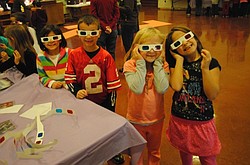
Neighbors | Shaiyla Hakeem .West Elementary first-graders Alayna Turillo (left), Anthony Canacci, Emah Fishbeck and Gia Ciavarella learned that robots view the world differently than humans. Their 3-D glasses let them see objects differently.
 Photo
Photo
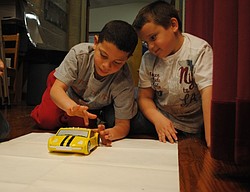
Neighbors | Shaiyla Hakeem .First-graders Chase Caroline (left) and Padraig McCarthy programmed directions into a pro-bot. The car turned and stopped according to the information typed into its database.
Students at West Boulevard Elementary learned how robots operate by rotating through six stations that focused on how they are programmed Dec. 3.
Since the school’s theme for this year is “Out of This World,“ the PTA thought learning about robots would be ideal. The Carnegie Science Center in Pittsburgh brought “Walking with Robots,“ an array of interactive learning activities geared to elementary students. This was the center’s first time visiting the school.
The first station, robot on a mission, required students to work together to walk across a path with their eyes closed. This was used to simulate how robots rely on their sensors to navigate. The second station, get with the program, let students program a small car with directing it when to stop and when to turn, which is similar to how robots are programmed.
Power me up, the third station, was a hands-on exercise where students put together a circuit board made of snap circuit pieces. This was used to teach them how electricity is used to power machines. No hands were allowed in the fourth station, robot remotely, because the students pretended to be robots and used prongs, instead of their fingers, to pick things up. Students learned that many robots view things differently than humans do in station five, robot responses. They wore 3-D glasses to see how the world looks.
The last station, who’s who, allowed students to build a binary code using their birth date. They learned that this code is used in devices such as computers.
First-grader Alayna Turillo’s favorite station was ‘robot remotely’ where she was able to act like a robot. She learned that robots have internal parts, like humans have internal organs, that work together to make them come alive.
“The robots actually have insides. I thought they were empty.” Turillo said.