 43
43

Valley foreclosures rise 4%
ASSOCIATED PRESS
 Photo
Photo
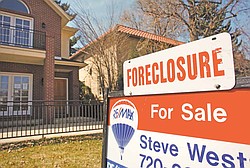
In this April 4, 2010 file photo, a forclosure sign tops the for sale sign outside a home in Denver. Foreclosure activity jumped in 149 of the 206 largest metropolitan areas in the U.S. last year, foreclosure listing firm RealtyTrac Inc. said Thursday Jan. 27, 2011.
Home Insecurity 2011
 Document
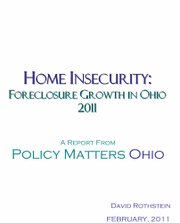
This report analyzes the new foreclosure filings statistics in Ohio along with some of the latest developments in foreclosure prevention efforts.
By Kristen Russo
YOUNGSTOWN
While most other Ohio counties saw a slight decrease in home foreclosures in 2010 — for the first time since 1995 — Mahoning County saw an increase of almost 4 percent compared with foreclosure numbers from 2009.
There were 1,819 Mahoning County homes foreclosed upon in 2010. Compared with numbers from 2000, when Mahoning County had 925 foreclosure filings, that’s an increase of almost 97 percent. Compared with 1995, when the county had 321 foreclosure filings, it’s an increase of almost 467 percent.
The numbers come from a report by Policy Matters Ohio, a nonprofit, nonpartisan policy-research institute that focuses on tax and budget policy, employment, wages, housing, education, energy and economic development. It has offices in Cleveland and Columbus.
“What’s striking to me is that [foreclosure numbers] in most other urban counties declined, and Mahoning went up, which says a lot about the resurgence of foreclosures in that area,” said David Rothstein, a researcher with Policy Matters Ohio.
Rothstein said the numbers in Mahoning County previously had been improving.
In 2009, Mahoning County foreclosure numbers dropped to 1,755, down from 1,836 in 2008, according to the report.
When measured in terms of population, the county is ranked 14th out of Ohio’s 88 counties. It had a rate of 7.68 foreclosures per 1,000 people in 2010. The county’s total population in 2009, the most recent year for which population data is available, was 236,735.
The 2010 foreclosure rates for other Northeast Ohio counties varied.
For example, although Cuyahoga County experienced a decline of almost 10 percent in 2010 compared with 2009, it still holds the record for the urban county with the most foreclosures in 2010. The county had 12,825 foreclosure filings last year.
Stark County is the only county that had a lower foreclosure rate than the state when measured in terms of population. With a population of 379,466, the county had 6.72 foreclosures per 1,000 people, while the state averaged 7.41 per 1,000.
According to estimates from the U.S. Census Bureau, Ohio’s population was 11,524,645 in 2009.
Of the 10 largest urban counties in the state, three of them, Mahoning included, saw an increase in foreclosure rates last year, according to the report. Franklin and Butler counties had increases of about 2 percent and less than 1 percent, respectively.
Foreclosures, which once were more heavily concentrated in urban areas, have been increasingly affecting rural areas as well. Preble County, the Ohio county with the second-highest foreclosure rate in terms of population, has 41,422 people living within its borders. Its 2010 foreclosure rate was 9.27 per 1,000 people.
Citing data from First American Core Logic, the report also said that Ohio is ranked sixth nationally for the number of homes with negative or near- negative equity. For more than 578,000 mortgages, the debt exceeds the current value of the home.
The report estimates that foreclosure rates would have been higher had the numbers not dropped after September, an effect of the “robo-signing” controversy in which some large banks postponed foreclosure filings after signing errors had been found on legal documents.
Bill Faith, executive director of the Coalition on Homelessness and Housing in Ohio, agrees.
“The report illustrates how the decrease in foreclosures at the end of 2010 was tied directly to the self- imposed moratoria by the nation’s largest banks brought on by their own ‘robo-signing’ debacle,” Faith said in a press release.
The report names JP Morgan Chase and GMAC, now Ally Financial, specifically.
Mary Kay Bean, spokeswoman for Chase, didn’t deny the claims but said foreclosure always has been the bank’s last resort.
“We’ve prevented foreclosures at about twice the rate of ones we’ve acted on,” Bean said.
Bean said Chase has a home-ownership center in Cleveland. At the center, homeowners who are having a difficult time paying their mortgages can meet with a counselor to discuss payment options and loan modifications. They also can visit Chase.com/myhome to download forms for a loan modification.
Jim Olecki, spokesman for Ally Financial, said that while other banks halted foreclosures, GMAC never did.
“What distinguishes us is that we didn’t issue a moratorium. We temporarily suspended foreclosure filings to review files that may have been affected. As each file was reviewed, we continued moving along,” Olecki said.
Olecki also said that through the review, the bank found no evidence of inappropriate foreclosures.