 43
43

Being nitpicky: It’s not nice when your kids have lice
MCT
 Photo
Photo
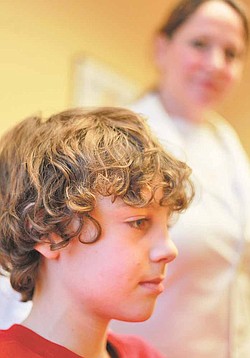
Sarah Casello-Rees, owner of The Lice Brigade and the boutique in Ann Arbor, Michigan, appears with her son, Donovan Rees, 7, who had lice for the first time in 2007. His lice prompted her to start her business one year later.
MCT
Photo
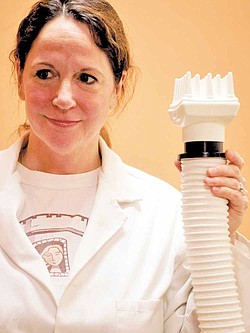
Sarah Casello-Rees is the owner of The Lice Brigade and boutique in Ann Arbor, Michigan, which specializing in treating lice called Rapunzel's Lice. She holds the LouseBuster device that helps treat lice on Wednesday, January 19, 2011.
McClatchy Newspapers
DETROIT
When Sarah Casello-Rees discovered that her kindergarten-age son had head lice, she went into a frenzy — buying every potion and chemical treatment she could find. And then she discovered she had lice, too.
“I went into Hazmat mode. I just became anxiety-ridden at the thought that things were crawling through my hair,” said Casello-Rees, 47. “I would have paid anybody anything to help me.”
And that’s when the longtime Ann Arbor, Mich., personal trainer had an entrepreneurial “a-ha” moment.
In August 2008, she opened the Lice Brigade, treating customers with nontoxic products and a manual comb-out to remove lice and nits.
Now, she can send any one of eight nitpickers — she calls them practitioners — to homes or schools to take care of an infestation.
She also has an Ann Arbor office, known as Rapunzel’s Lice Boutique, where she treats customers.
And since December, she’s acquired the LouseBuster, a device approved by the U.S. Food and Drug Administration as a nonchemical treatment for getting rid of lice. The LouseBuster is a vacuumlike machine that shoots hot, dry air onto the scalp, which kills the lice and eggs.
In the first two weeks of the year, she treated 41 people with the LouseBuster, at $145 each. The traditional treatment, manual combing, is $95. There are additional charges for at-home visits.
Her business draws the lice- besieged from near and far.
She had a family from Missouri drive 12 hours to her shop so that a single mom and her long-haired teenage daughters could get the treatment.
Recently, a Detroit-area Catholic school asked her and her staff to check the scalps of 450 students.
Any time school or camp is in session can be the right time for lice to spread.
It’s spread most directly from head-to-head contact. But it also can be transmitted by sharing combs, headgear and clothing.
Lice afflict people regardless of wealth or social status or personal hygiene.
Recently, parents at Rosedale Elementary School in Livonia, Mich., received notices that several students had lice. School officials had professionals check the scalps of the 300-plus students in kindergarten through fourth grade.
There are no hard numbers on head-lice outbreaks.
That’s, in part, because the state of Michigan does not require the condition to be reported to health officials.
Jill Girardot of the Macomb County Health Department said the county’s school districts reported 978 head-lice cases in 2010.
“It’s useful when parents call and we tell them the school has reported” the case, said Girardot.
In July, the American Academy of Pediatrics released a report that suggested that many cases of head lice are false. The report cited a study of 600 samples taken from children’s scalps believed to be infested with lice, and found that two-thirds were dandruff, scabs, dirt, hair-spray droplets, or already dead or inactive lice eggs.
The Michigan Department of Community Health manual on head lice notes that it “does not pose a significant health hazard and is not known to spread disease. The most common symptom is itching due to sensitization to allergens in lice saliva. Many times there are no symptoms.”
But an outbreak requires a good deal of cleaning — vacuuming of upholstery, carpets and mattresses, and hot-water washing of linens and clothes — to ensure there isn’t a further spread of the critters.
“The largest impact of head lice comes not from the condition itself but from our culturally-based reactions and emotions toward the condition,” says the Michigan Department of Community Health manual on head lice.
Casello-Rees understands the panic.
When her son, Donovan Rees, first had lice in 2008, he was one of 18 kids in a kindergarten class of 23 carrying them.
“He was one of the 60 percent of cases that had no symptoms. He didn’t itch. But he probably had them for months,” recalled Casello-Rees. “At the store, I bought everything off the shelf. The check out girl looked at my purchases and said ‘Oh, this doesn’t look good.’”
But she managed to turn her son’s bout with head lice into a career.
Casello-Rees says she’s proud of what she does and how it helps people in obvious distress. And she has come to terms with dealing with crawling creepy critters.
“I joke that when I tell people what I do they take a couple of steps back,” she says. Yet, clients are grateful for the service she provides.
“Some of them want to hug us,” she says. Still, even though she knows that it’s difficult to contract lice without head-to-head contact, “we say no thanks.”
Questions and answers about lice and videos on how to detect and treat it can be found at www.headlice.org.
Copyright 2011 Associated Press. All rights reserved. This material may not be published, broadcast, rewritten, or redistributed.