 43
43

Public library in peril next?
The Vindicator (Youngstown)
 Photo
Photo
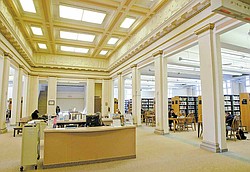
Main Library patrons look through stacks and read at a study area inside the facility. An architectural study recommends $11 million worth of improvements to the library.
The Vindicator (Youngstown)
Photo
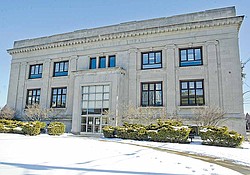
The main branch of The Public Library of Youngstown and Mahoning County in downtown Youngstown.
 Photo
Photo
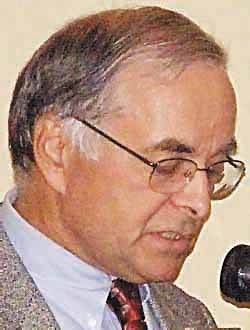
Carlton Sears, director of The Public Library of Youngstown and Mahoning County
The Vindicator (Youngstown)
Photo
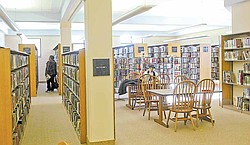
Main Library patrons look through stacks and read at a study area inside the facility. An architectural study recommends $11 million worth of improvements to the library.
Building called ‘challenged;’ $11M upgrade proposed
YOUNGSTOWN
An architectural study recommends nearly $11 million in upgrades to the century-old Main Library at Wick and Rayen avenues.
The Public Library of Youngstown and Mahoning County commissioned the evaluation by Faniro Architects Inc., and it was presented recently to the library system’s board of trustees.
“This report should be considered fair warning. The Main Library building is challenged,” and addressing the challenges “will be costly,” Library Director Carlton Sears wrote in a foreward to the architect’s report.
Sears told the trustees he wants to ensure that the MainLibrary does not suffer the same deterioration the Mahoning County Courthouse has experienced.
Both buildings are of the same vintage and were designed by the noted architectural firm of Owsley, Boucherle and Owsley; and both are on the National Register of Historic Places.
“We are not planning any immediate action, nor do we have the money to take on this project at this time,” Sears said.
Although improvements to the main library are mentioned in the library’s strategic plan, the library board has made no commitment to perform any of the work Faniro recommended.
Sears and Architect Ronald Cornell Faniro told the trustees the main library would not necessarily have to close during the renovations, but Sears said the work might cause significant inconvenience for library operations.
Main Library, whose construction was funded in part by a gift from industrialist Andrew Carnegie, is the oldest and largest facility and the administrative center of the 16-branch library system.
The 46,000-square-foot front portion of Main Library, 305 Wick Ave., opened Dec. 3, 1910, with an exterior entrance stairway from Wick Avenue and a centrally located circulation desk, from which staff served patrons and monitored the library.
In 1994, a 29,000-square-foot rear addition was made, with a new entrance from the parking lot on the north side of the library.
Although the two buildings are connected, they are separated by an elevator and a multi-tiered column of low-ceiling book stacks at the back of the original building, and they now require multiple patron service points throughout the library, the architect’s report observed.
Faniro’s report proposes removing the stack barrier, relocating the elevator and returning to the original central patron service desk, with the new central desk straddling and serving both buildings.
Converting multiple service desks to a single central desk would require less staff to serve patrons and monitor the library, Faniro said.
Faniro’s plan also calls for restoration of the exterior Wick Avenue entry stairs, which were removed in a 1954 renovation. That restoration would “reassert the main library’s presence along Wick Avenue,” Faniro said.
Faniro recommends restoration of the original skylights to maximize natural light, replacing all roofing and first- and second-level flooring, moving the meeting room from the basement to the second floor and repainting the entire library interior.
The architect also recommends a 3,750-square-foot, single-story addition to the 1994 building to house a new entrance and an expanded children’s collection.
The report features an appendix by J.M. Verostko Inc. of Youngstown, heating and cooling consultants, which recommends replacing major components of the library’s heating and cooling systems, which are approaching or have surpassed their life expectancies, with more energy-efficient and cost-efficient equipment.
Another appendix from C.L. Firestone Inc. of Youngstown, consulting engineers, recommends replacing electrical wiring and conduits and light switches in the original building and replacing most of the library’s lighting with newer, brighter and more energy-efficient fixtures.
The architect’s evaluation and its appendices cost the library system $32,100.
In the computer age, the library “faces a future in which the means and environment of delivering information will supersede the physical presence of that information and the need to physically expand,” Faniro wrote.