 43
43

Winter animal lessons
 Photo
Photo
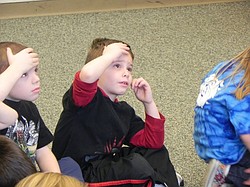
During the Mill Creek presentation at Dobbins Elementary, host Ray Navotny asked the children to feel their foreheads. After Mike Nicholudis (center) tested his forehead, Lavotny said that hibernating animals lower their temperature to 50 degrees to save energy.
 Photo
Photo
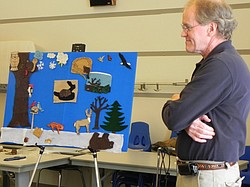
The Mill Creek staff used a felt board and attachments to illustrate how animals survive the winter. Mill Creek representative Bob Coggeshall looked over at a surprisingly busy winter scene.
 Photo
Photo
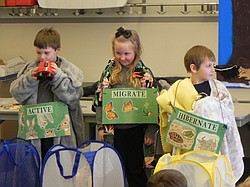
The Mill Creek representatives dressed students in "winter animal" outfits. Active Caden Evans (left) wears a warm coat and looks for food with his binoculars; Preslic BoDine (center) wears a tropical shirt after migrating to a warmer climate; Zach Martin (right) hibernates with a warm blanket and an alarm clock.
 Photo
Photo
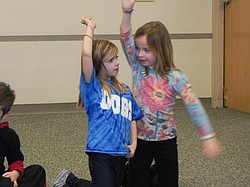
Neighbors | Sarah Foor .During a Jan. 20 "Winter Animals" presentation by Mill Creek Park, Maria Havlin (left) and Ava Nicholudis (right) were eager to answer questions during discussion.
By SARAH FOOR
Mill Creek Park naturalists Ray Navotny and Bob Coggeshall ventured out of the wintery wonderland of Mill Creek Park to teach Dobbins kindergartners about winter animals on Jan. 20.
“These programs are one of the very few times we venture out of the park,” Navotny shared with a laugh. “But we leave because it’s important for the kids to understand Ohio wildlife during the winter time, and what a great resource the park is to discover these processes.”
Navotny explored winter animals with the kindergarten students of Dobbins teachers Eliane Fabrizi and Stephanie Mateja. Navotny made the event kid-friendly by asking questions often and illustrating his discussion with a felt landscape that included the homes and supplies that winter animals use to survive in the winter time.
To illustrate how humans are active winter animals, Navotny asked with urgency, “We’re getting a snow storm! How do you prepare?”
Mike Nicholudis answered that he would help light a fire in the fireplace, while Maria Havlin suggested buying extra food to last the storm.
“That’s what makes us active winter animals,” Navotny related. “We can survive during the winter, we just have to be a bit prepared. Squirrels, rabbits, mice, deer, and foxes are active winter animals, too.”
After the discussion, Coggeshall took over to play a game with the students.
“I really hope you were paying attention,” he said.
The students were tested by placing a plush animal in a hamper that either represented whether the animal hibernates, goes dormant, migrates, or stays active in the winter time. The Dobbins kindergartners wowed the Mill Creek representatives by placing all the animals correctly.
“You are definitely all winter animal experts,” Coggeshall told the students.