 43
43

Youngstown, bank building owner reach deal on scaffolding
The Vindicator (Youngstown)
 Photo
Photo
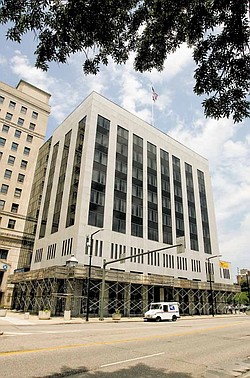
It will be another five to six months before scaffolding around the PNC Bank Building in downtown Youngstown is removed. The owners of the building want to install 54 metal strips to the building to stabilize granite panels on its exterior.
YOUNGSTOWN
The scaffolding surrounding the PNC Bank Building since May 2008 will remain for another five or six months under an informal agreement between the property’s owner and a city committee that oversees exterior work on downtown structures.
Three of the seven members of the city’s Design Review Committee met Tuesday with Anita Atheneos, property manager for Park South Development Co. LLC, which owns the downtown building, and Isaac C. Lewin, an engineer from South Euclid hired by the company to design repair work to the structure.
The committee was shy one member of having a quorum, so it could take no official action.
But the three members — city Community Development Agency Director Bill D’Avignon, Deputy Director of Public Works Charles Shasho, and Phil Kidd, who works for the Mahoning Valley Organizing Collaborative — came to an understanding with Atheneos and Lewin.
Park South wants to install 54 steel strips — each about 20 feet long, 4 inches wide and a quarter-inch thick — between the granite panels on the exterior of the building, located at Wick Avenue and Commerce Street. Two large pieces of granite fell from the structure about 40 feet to the sidewalk in 2005.
The three DRC members asked that two or three strips be installed so they can see if they like the look.
“It appears as though it’s something that will work,” D’Avignon said. “We’re a little bit concerned with the overall aesthetics. They’ll do a sample so we can see it.”
Shasho added: “It’s better than what’s there right now. We want something that will get the scaffolding removed and something that doesn’t look too crazy. We don’t want it to look like prison bars.”
It will take a month to six weeks to get the two or three test strips made and then installed.
The metal strips will be painted to match the building’s granite, Lewin said.
If DRC gives its approval, it will take two months to have all of the strips made and another two months to install them, he said.
The strips would be mounted on the building and screwed into the granite panels to hold the panels in place, Lewin said.
The scaffolding was erected in May 2008 after the company finally acknowledged that two large pieces fell off the building three years earlier. Nothing has fallen since.
Park South has done nothing to improve the exterior, except erect the scaffolding.
Park South was in litigation with the Cincinnati Insurance Co., the building’s insurance company, over replacing the granite.
Cincinnati wanted to pay about $15,000 to replace the two fallen pieces of granite. Park South wanted $1.8 million to replace all of the granite as well as about $80,000 for the scaffolding.
That lawsuit was settled in November 2010. The terms of the settlement are sealed, Antheneos said.
Installing metal strips would cost about $250,000, Lewin said.
Another issue was Park South kept the scaffolding up past the Jan. 24, 2010, expiration date on the permit for it. An article in June 2010 in The Vindicator disclosed the permit’s expiration date. A day after the newspaper published an article on the situation, Park South submitted a proposal to the city to replace the exterior on the building’s main tower portion.
Also at the time, city officials said they were considering legal action against the building’s owners for violating city code regarding the scaffolding and unsafe condition of the building.
Not only wasn’t a lawsuit filed, but the city issued a new building permit in late July 2010 giving the company another 12 months to make the improvements.
“As we were preparing to litigate, and we still stand ready, the building owner and their insurance company reached a settlement,” Mayor Jay Williams said. “Remember, the goal is to remedy the situation as quickly and as pragmatically as possible. We will monitor the progress carefully. If sufficient progress is not being made, we still have the option to litigate.”