 43
43

Right touch
 Photo
Photo
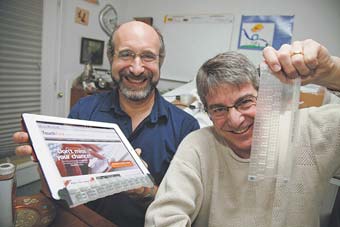
Steven Isaac, left, and Brad Melmon, director of product development of TouchFire, display the silicone overlay that goes on top of the virtual keyboard of an Apple iPad.
Associated Press
SAN FRANCISCO
Even if you love the iPad, you’re probably not keen to write your next novel using its onscreen virtual keyboard. You may not be thrilled to type up a lengthy email with it, either.
Steve Isaac felt the same way. A Seattle-based software designer who worked on an early tablet at computing startup Go in the ’90s, Isaac was delighted when the iPad came out last year. He loved its svelteness, battery life and wireless connectivity.
“The iPad was amazing,” he says. “It just did everything super, super well.”
Well, almost everything. Though its touch-screen keyboard was miles ahead of what he’d seen on past tablets, he felt it still wasn’t great for typing. And wireless keyboards that work via Bluetooth seemed too bulky.
So Isaac got to work on a way to make the iPad easier to type on — a stretchy silicone keyboard called the TouchFire that sits atop the tablet’s onscreen keyboard when the device is turned on its side.
Isaac isn’t unique in coming up with this type of device, but his invention has garnered an intense amount of support through Kickstarter — a website where entrepreneurs and artists solicit funding for their projects and often give rewards in exchange, such as a limited-edition poster or first version of a product.
In Isaac’s case, he turned to the site to raise money to turn his prototype into a real device, offering the first run of TouchFires to Kickstarter backers. His effort raised $201,400 by the time it ended last week. That was more than 20 times the $10,000 that he and his business partner had hoped to snag.
The TouchFire’s birth as a consumer product shows the growing importance of sites such as Kickstarter. They offer a new way to finance bright ideas and usher them to the masses. Kickstarter visitors can search through a bevy of proposals for everything from graphic novels to consumer electronics, coming from creators who must meet their stated funding goal in a specified period of time in order to actually use the money.
About 45 percent of the projects meet or exceed their goals, Kickstarter said. This year, site visitors pledged about $79 million to projects that either succeeded, including Isaac’s, or were still in the process of soliciting funds.
The response to the TouchFire in particular indicates that, despite the tough economy, people are interested in shelling out for ideas they believe in — something that benefits both consumers and entrepreneurs.