 43
43

Simulation raises awareness of poverty
The Vindicator ( Youngstown)
 Photo
Photo
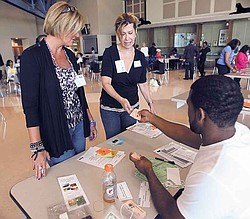
Martha Romine and Rita McNamara exchange cash for bus tickets with Malcom Horton on Monday during a Community Action Poverty Simulation at East High School. Participants, which included East High faculty, interacted with social-service agencies, grocers, police officers, pawnbrokers, bill collectors and prospective employers to get an idea of what low-income people go through.
 Photo
Photo
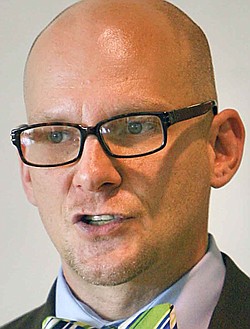
Dustin Speakman
The Vindicator ( Youngstown)
Photo
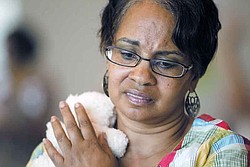
Kay White consoles her “child,” simulated by a stuffed animal, as she is given bad news that the pawn shop isn’t interested in her furniture and will pay for only one of her two microwaves. White was portraying a single, 19-year-old mother Monday during the poverty simulation at East High School.
The Vindicator ( Youngstown)
Photo
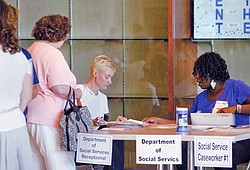
Julie Hazy, a reading specialist at East High School, applies for social services during a Community Action Poverty Simulation Monday at the school. Participants were assigned roles of low-income people such as an elderly person on a fixed income or a single mother supporting two children with a minumum-wage job. They interacted with human service agencies, prospective employers, pawn brokers, utility companies and others, simulating what low-income individuals and families go through.
By Denise Dick
Youngstown
East High School technology teacher Kay White rushed around the school cafeteria trying to pay her bills and get a roof over her baby’s head.
White was portraying the 19-year-old single mother of an infant, as part of Community Action Poverty Simulation on Monday presented by the Ohio Association of Second Harvest Foodbanks. Second Harvest Foodbank of the Mahoning Valley is the association’s local partner.
“The idea is to raise awareness about the barriers that low-income people face,” said Dustin Speakman, director of community services for the association.
Participants from the school district were assigned roles: grandparents raising their grandchildren, an elderly person living alone and on a fixed income, single parents with difficult children.
They received packets of information detailing individual situations, monthly income and financial obligations and had to visit different agencies including the utility company, social-services department, pawn shop, mortgage company, school district, employer and pay-day loan shop.
The exercise simulated a month — divided into four 10-minute weeks. Between weeks, they could return to their families to map their strategy for the next.
Speakman walked around during the simulation handing out cards to faculty with unplanned events detailing situations the individual had to address. Some of those situations were pleasant, such as a raise at work, and others were unpleasant, a dental visit for one of the kids.
While waiting for her mortgage broker to return to the office, White’s single mother is robbed. Police caught the thief, but she doesn’t get her money back. All she has is $23, and she’s nearing the end of the time she and her children can live at the homeless shelter.
Tenth-grade English teacher Kristin Dota portrayed an 85-year-old man who lives alone. She started her week with a visit to the social-services department where she got a voucher for food.
She had to wait and return another day to get a medical card. She pawned a chair to get money to buy transportation passes to get around.
Speakman said participants get no instruction but must weave their way through the system.
It helps to understands some of the issues students and their families must deal with in the lives, he said.
“In regard to student success, poverty is one of the barriers students face,” said Jennifer Walker, an English teacher at East.