 43
43

Rising cost of supplies puts parents in a school daze
 Photo
Photo
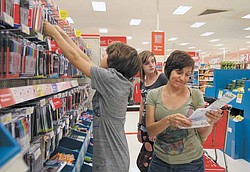
Nate Jones, 11, of Youngstown shops for back-to-school supplies with his sister, Lucy, 14, and mother, Lanore, at Target in Boardman. The Huntington Backpack Index, a project of Huntington National Bank, reported that the cost of school supplies this summer jumped significantly from last year.
By Karl Henkel
BOARDMAN
Lanore Jones has a simple approach when it comes to shopping for school supplies.
Get it done.
“I know they have specials at different stores,” said Jones, who recently shopped at Target in Boardman with her two children, Lucy, 14, and Nate, 11. “But I just try to get it done.”
Nate’s back-to-school list ran 25 deep and included highly specific items such as ultra-fine and fine-tip black permanent markers.
“How many permanent markers do the kids need?” Jones said sarcastically.
She estimated that by the time school starts, the cost of school supplies would surpass $100 — excluding clothes — which is a burdening cost but shallow compared to the average costs for a middle- or high-school student.
In fact, the Huntington Backpack Index, a project of Huntington National Bank, reported that the cost of school supplies this summer jumped significantly from last year.
Huntington has tracked the costs of back-to-school shopping for six years, and never before have costs risen so drastically.
“It’s amazing,” said Maureen Brown, public-relations director for Huntington. “Especially because the supplies haven’t changed a lot over the years.”
Huntington’s annual survey of the cost of items on school-supply lists found that between summer 2010 and now, high-school costs jumped 9 percent, from $1,000 to $1,091; elementary-school costs increased 12 percent, from $474 to $530, and middle-school costs rose 25 percent, from $545 to $681.
The list of requested items also seems to be growing.
In South Range, parents of kindergarten students are requested to provide two packages of Clorox wipes. At Struthers Middle School, parents are asked to provide a roll of paper towels.
“Over the years, we’ve seen hand sanitizers and Kleenex,” Brown said. “Those things are becoming more of a requirement in every school district.”
Brown said one new item being requested is jump drives, which can cost as little as $7.
That’s a relatively cheap form of technology compared to the TI-Nspire graphing calculator required by Algebra II, probability and statistics and intermediate algebra/geometry students at Austintown Fitch High School.
The schools offer the calculators, which come in two models, for $125 or $135. Retail costs for the calculators are as high as $160.
Some parents also have to worry about extracurricular costs. In Canfield schools, it costs $100 per student, per sport at the middle-school level and $200 per student, per sport at the high-school level.
So what’s a parent to do?
In terms of basic school supplies, there are a couple of options that have grown in popularity, according to a study conducted by Deloitte LLP.
About 55 percent of polled parents say they will buy only necessities, and 26 percent say they will reuse last year’s supplies in an effort to save money, something Andrea Woroch, consumer savings expert, says should be done first.
“When you get the [back-to-school] list, take inventory and shop at home first,” she said. “For an elementary student, if they need a box of crayons, look through their playroom or through a drawer and you could potentially put together a box of crayons.”
Consumers also plan to use smartphones and social networks as cost-savers. About two-thirds of surveyed shoppers said they plan to use smartphones, using applications such as Coupon Sherpa, for back-to-school shopping and to get price information. About 43 percent said they’d use smartphones to download coupons or discounts.
One-third of consumers will use social networks, according to the study.
“It’s playing a big part in consumers finding ways to save,” Woroch said. “We see a lot of retailers building Facebook stores.”
Woroch said retailers, currently fighting over belt-tightened consumers, are going the extra mile by offering online promotions and special coupons.
“Any consumer who is a fan or likes a certain page will get those updates in their news feed in real time,” she said. “It’s a win-win for the retailers and the win-win for the consumers.”