 43
43

April showers may bring another record for Valley
The Vindicator (Youngstown)
 Photo
Photo
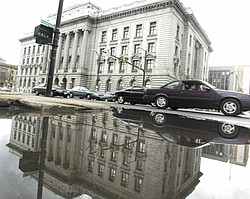
The county courthouse in downtown Youngstown is reflected in standing water Monday after more than a week of rain.
YOUNGSTOWN
Every month since November 2010, the Mahoning Valley has made the top 10 in most snow or most precipitation — including February when it made both lists — in the area’s weather history.
The Valley easily could break the record for the wettest April. As of Monday afternoon, there was 6.23 inches of precipitation this month. The record is 7.29 inches in 1998.
There’s rain in the forecast for the rest of the month.
“We’ve had one storm after another, and the next several days, we’ll have [the same] weather,” said Sarah Jamison, a hydrologist with the National Weather Service in Cleveland. “It won’t shut off for the next several days. We won’t have a dry patch anytime soon. It’s very likely we’ll see at least another inch of rain” before the month ends.
But for the month of May, the weather service is expecting normal rainfall, Jamison said. Normal rainfall for May in the Valley is 3.45 inches.
Until then, “grass will grow, and you won’t have time to mow it,” she said.
Joyce Marrie, floor manager at Kraynak’s in Hermitage, Pa., said though the store hasn’t begun its spring plant sale, she doesn’t anticipate a continuance of the cold, wet weather will deter those with a green thumb from getting their gardens going.
“When it comes to gardening, people tend to get out there regardless of the weather,” she said. “As long as it’s above freezing, they’ll be out. They’re anxious.”
Marrie said the wet weather did hurt Easter and spring outdoor-decorations sales, however.
“We’ve seen a drop on those items this year,” she said. “People just couldn’t get outside to decorate.”
Though snow and rain are precipitation, they are not created equal, Jamison said.
Snow is considerably less moist than rain, she said.
Rain is a straight measurement: One inch of rain equals 1 inch of precipitation.
Depending on the type, about 10 inches of snow — the wet, heavy kind — is equal to 1 inch of precipitation, with about 12 to 13 inches of lake-effect snow equal to 1 inch of precipitation, Jamison said.
In November, 4.45 inches of precipitation (and just a trace of snow) fell, the eighth-wettest in the Valley’s weather history, dating back to 1896.
In December, the Valley had more snowfall than any other month in its weather history, 53.1 inches.
A month later, 30 inches of snow fell, good enough for the seventh-snowiest January on record.
Both were largely lake-effect snow, so there wasn’t much precipitation.
In February, 20.6 inches of snow fell, primarily the wet, heavy kind. The snow amount was the eighth-most for a February, and the 5.03 inches of precipitation was good enough for the third-wettest February.
Last month, there was 5.14 inches of precipitation, the ninth-wettest March on record.
Also, primarily because of the snow in December, January and February, this past winter season was the area’s snowiest on record with 118.7 inches.
Contributor: Elise Franco