 43
43

Lawyer for Madoff victims has thankless job
ASSOCIATED PRESS
 Photo
Photo
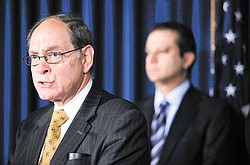
Irving Picard, Securities Investor Protection Act Trustee, left, is joined by U.S. Attorney for the Southern District of New York Preet Bharara during a news conference, Friday, Dec. 17, 2010 in New York. The trustee recovering money for Bernard Madoff's burned investors has reached a settlement with the estate of a Florida philanthropist and businessman who made billions of dollars off the fraud.
Associated Press
NEW YORK
Everyone’s mad at Irving Picard.
To be fair, his job is thankless: He’s the court- appointed bloodhound in charge of hunting down money for the victims of Bernard Madoff, a man who was so skilled at hiding money that he kept the biggest scam in the history of American finance going for at least two decades.
Wall Street hates him. Picard has sued more than a dozen banks, including several whose big link to the Ponzi scheme was one step removed — helping people bet on funds that bet on the fund run by Madoff.
Fans of the New York Mets, which have enough problems on the field, are angry at him for suing the team’s owners for $1 billion, just when they’re trying to find new owners and are still reeling from their own Madoff-related losses.
And most bizarrely, some of the people Madoff ripped off say Picard has screwy ideas about the law and is making them victims all over again by demanding they hand back “fictitious profits” that many already have spent.
A little more than two years into the job, the 69-year-old Picard, who was plucked from obscurity to recover the money, has become America’s most unlikely celebrity lawyer and perhaps its most underrated.
He’s filed more than 1,000 suits in 30 countries and defied expectations by bringing in $10 billion so far. That’s half of what he estimates investors lost in principal when Madoff was arrested, though not as impressive compared with the phony $65 billion that Madoff claimed they had.
To make a bigger dent, Picard will have to wrest money from those banks he’s sued. It won’t be easy. Picard says they saw plenty of red flags and had an obligation to warn investors. The banks say Picard has gotten his facts wrong and his legal logic is flawed. Some prominent attorneys seem to agree.
“He’s pushing the envelope,” says Harvey Miller, a well-known bankruptcy lawyer at Weil, Gotshal & Manges who has known Picard for decades. “What is the duty of banks and financial institutions? It’s a gray area of the law.“
Self-effacing and mild-mannered, Picard is not the first person you’d associate with aggressive legal tactics and a ruthless hunt for money. Then again, he’s difficult to pin down, a blend of seemingly conflicting characteristics.
Picard, a lawyer at Baker & Hostetler, turned down an interview request from The Associated Press, but two dozen friends, acquaintances and colleagues who did agree to talk describe a man whose deferential manner belies his tenacity, someone who can seem alternately pragmatic and idealistic, shrewd and empathetic.
Picard is the youngest child of Jewish refugees from Nazi Germany. They fled to the U.S. in 1938 after the father’s medical practice was destroyed by a Nazi law barring non-Jewish patients from seeing Jewish doctors, according to Ernest Picard, one of two older brothers who left with the parents.
After the University of Pennsylvania and Boston University law school, he landed a job as a lawyer at the Securities and Exchange Commission, where he rose to oversee a legal team handling bankruptcy cases. He gained a reputation as someone who wasn’t hidebound by the agency’s old practices, and for a human touch.
In 1979, Picard was appointed one of 12 U.S. trustees in a new Justice Department program charged with overseeing corporate bankruptcies. “If he decided something was unfair, he went after it,” says former trustee David Coar, recalling how Picard would attack lawyers representing creditors for withdrawing big money from bankrupt companies to pay themselves. “There were no sacred cows.“