 43
43

Students get look at Ohio wildlife
 Photo
Photo
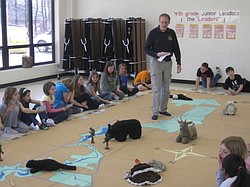
Neighbors | Abby Slanker.Bob Coggeshall, a Mill Creek MetroParks naturalist, presented the program Wildlife of Ohio to fourth-grade students at Hilltop Elementary School March 18.
 Photo
Photo
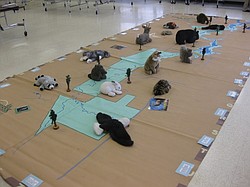
Neighbors | Abby Slanker.Mill Creek MetroParks naturalists visited Doug Dawson’s fourth-grade students at Hilltop Elementary School and brought a large floor map of Mill Creek Park and props to help them with their program Wildlife of Ohio..
 Photo
Photo
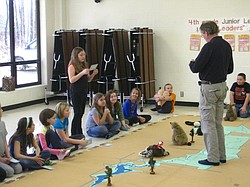
Neighbors | Abby Slanker.A Hilltop Elementary School fourth-grade student read her information card aloud during Mill Creek MetroParks’ program Wildlife of Ohio, presented by naturalist Bob Coggeshall (right)..
 Photo
Photo
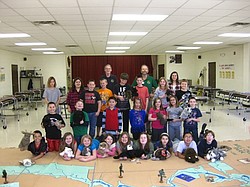
Neighbors | Abby SLanker.Mill Creek MetroParks naturalists, from left, (back row) Bob Coggeshall, Ray Novotny and Bethany Feustel presented the program Wildlife of Ohio to Doug Dawson’s fourth-grade class at Hilltop Elementary School March 18..
By ABBY SLANKER
Students in Doug Dawson’s fourth-grade class at Hilltop Elementary School were treated to an interactive Ohio wildlife lesson from Mill Creek MetroParks naturalists March 18.
The program, titled “Wildlife of Ohio,” explained in detail the course Ohio wildlife has taken from 1803, the year of Ohio’s statehood, until 2008.
Mill Creek MetroParks naturalists Bob Coggeshall, Ray Novotny and Bethany Feustel presented the program. Dawson has invited the naturalists to his class for the past several years to coincide with his social studies lesson on the state of Ohio.
They brought with them a large floor map of Mill Creek Park and placed, in chronological order, information cards around the edges of the map. To help make their points, stuffed animals, including a turkey, snake, raccoon, deer, bobcat and bear, and small trees representing forest land, were randomly placed on the map.
The students were seated around the map with an information card in front of them. Each child was then asked to read a card aloud, starting with 1803, and had to act out what the card said.
For example, one card read, ‘1954 - The river otter was no longer found in Ohio rivers and streams because of polluted water.’ The student would then find the river otter on the map and take it off the map.
If a card said an animal was re-introduced to Ohio, the student would place that animal back on the map. Some animals were returned, but were placed on the endangered species list, and were placed near the endangered species sign on the map.
According to Coggeshall, laws have been passed to protect some animals, and those animals were able to make a comeback in Ohio.
“These laws have been very helpful in building up wildlife populations. In your lifetime, you will see more improvement with the Ohio wildlife situation,” Novotny told the students.