 43
43

Physicians are more accessible thanks to technology
MCT
 Photo
Photo
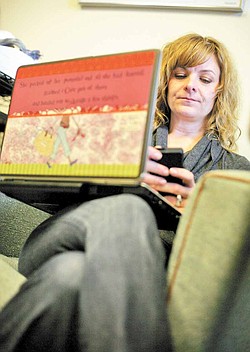
Kristen Cullen, of West Bloomfield, uses her laptop and smart phone to keep in communication with her husband Niall's doctors at the Karmanos Cancer Center in Detroit, Michigan, March 15, 2011. Cullen has been her husband's caregiver since he was diagnosed with colon cancer three years ago. (Andre J. Jackson/Detroit Free Press/MCT)
McClatchy Newspapers
DETROIT
Almost a year ago, Kristen Cullen’s husband broke out in hives from head to toe. She suspected he was having an adverse reaction to medication. But she wasn’t sure what to do. It was late on a Sunday evening. Not typical doctor hours.
But Cullen didn’t panic.
She turned to one of the trusted tools she has come to rely on since Niall Cullen was diagnosed with colon cancer: her cellphone. She called his oncologist, Dr. Philip A. Philip of the Barbara Ann Karmanos Cancer Institute.
Philip immediately arranged for Niall to be admitted to the hospital. Once there, the attending physician used his cellphone to email a photo of Niall to Philip and other physicians handling his case.
Increasingly, caregivers like Cullen and patients are texting, emailing, even using Skype to reach health care providers. Many doctors and patients find that newer technologies help strengthen their communication.
“Certainly the explosion in the use of smart phones will mean more and more patients will be communicating with their health- care providers using either email or text messaging,” says Philip. “I feel that with improved communication options for patients and families, better care can be provided, and patient or family concerns addressed in a more timely fashion or in real time.”
In Niall’s case, doctors quickly developed a treatment plan that eliminated the hives and got him back to work within a couple of days.
“I fear what could have happened had I not been able to get hold of Dr. Philip,” says Kristen Cullen. “They told me that on a scale of 1 to 10 for adverse reactions; he was at Level 9. It was life-threatening if he hadn’t been seen and treated as quickly as he was.
“My phone is my lifeline to his doctors,” Cullen says.
While many patients find such technology extremely useful, some doctors remain reluctant to use it even though the demand is pushing more and more doctors to communicate electronically.
A national poll of 1,612 parents showed that more than half of them would find electronic communication with their children’s health- care providers very helpful, but fewer than 15 percent of those parents were actually able to communicate electronically with their child’s pediatrician or other health- care providers.
“The study found a big gap between what parents can currently do and what parents feel would be helpful,” said Dr. Matthew Davis, director of the C.S. Mott Children’s Hospital National Poll on Children’s Health at the University of Michigan. Davis, a pediatrician, says he is comfortable with electronic communication. “My email address is on my card,” he says. But Davis said he recognizes that some doctors are concerned about medical liability, privacy and compensation.
While there are no universal guidelines for electronic communication between physicians and patients, most doctors use it only with patients with whom they have already established a relationship. “We need to see electronic messaging as a replacement for a phone call,” Davis says, “not as a substitution for a visit.”
Davis and others expect electronic communication to increase due to demand.
“I think it’s inevitable that physicians will move more toward it, if only because society expects and insists on it as the progressively dominant form of communication today,” Davis said.
Kristen Cullen believes technology saved her husband’s life.
She keeps her phone with her constantly, and sometimes has her laptop at her side.
When there’s a new development, she emails his doctors with an update. Doctors usually respond shortly thereafter with a text, an email or phone call.
Niall Cullen used his smartphone only once to communicate with his doctors.
On Father’s Day a couple of years ago, he emailed a photo he took of one of his sons at Little League championship game in Cooperstown, N.Y.
“Thanks for giving me another Father’s Day,” his message read.
Copyright 2011 Associated Press. All rights reserved. This material may not be published, broadcast, rewritten, or redistributed.