 43
43

Safes, cash wash up on shores in Japan
AP
 Photo
Photo
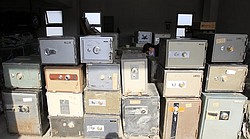
In this photo taken on April 7, 2011, a police office cleans cashboxes after they collected those from damaged houses at a police station in tsunami-hit Ofunato city, Iwate Prefecture, Japan. Safes were washing up along the tsunami-battered coast, and police were trying to find their owners, a unique problem in the country where many people, especially the elderly, still stash their cash at home.
Associated Press
OFUNATO, Japan
There are no cars inside the parking garage at Ofunato police headquarters. Instead, hundreds of dented metal safes, swept out of homes and businesses by last month’s tsunami, crowd the building.
Any one could hold someone’s life savings.
Safes are washing up along the tsunami-battered coast, and police are trying to find their owners — a unique problem in a country where many people, especially the elderly, still stash their cash at home. By one estimate, some $350 billion worth of yen doesn’t circulate.
There’s even a term for this hidden money in Japanese, “tansu yokin.” Or literally, “wardrobe savings.”
So the massive post- tsunami cleanup under way along hundreds of miles of Japan’s ravaged northeastern coast involves the delicate business of separating junk from valuables. As workers and residents pick through the wreckage, they are increasingly stumbling upon cash and locked safes.
One month after the March 11 tsunami devastated Ofunato and other nearby cities, police departments already stretched thin face the growing task of managing lost wealth.
“At first we put all the safes in the station,” said Noriyoshi Goto, head of the Ofunato Police Department’s financial affairs department, which is in charge of lost-and-found items. “But then there were too many, so we had to move them.”
Goto couldn’t specify how many safes his department has collected so far.
If neither owner nor finder claims it, the government takes possession.
Meanwhile, some families have moved into temporary housing, while Japan’s prime minister promised Sunday to help fishermen along the devastated coast get back to their boats.
Rows of 36 boxy houses line a school parking lot in this port city pulverized by the tsunami, and, after a lottery, the first lucky families moved in this weekend. Each unit is just 320 square feet, but replete with modern comforts such as a television, refrigerator, microwave and washing machine — a welcome upgrade for the homeless.
The city hopes to complete 400 units in eight different locations by mid-May, although that will still only cover about one-quarter of the families in need.