 43
43

Cruising the moon at YSU
The Vindicator (Youngstown)
 Photo
Photo
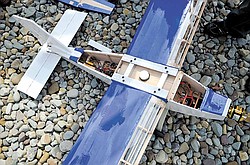
YSU senior mechanical engineering students Tasha Reid, Brendan Mahoney, Adam Seelman and Mark Harvey present their project, a crop duster, during Youngstown State University's STEM Showcase Satruday afternoon.
The Vindicator (Youngstown)
Photo
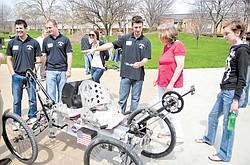
Youngstown State University senior mechanical-engineering student Kevin Miller speaks to Susan Halley of Pittsburgh about the moon buggy he and fellow students built. The lunar vehicle was one of many projects the YSU College of Science, Technology, Engineering and Mathematics displayed as attractions at Sunday’s annual STEM showcase at Moser Hall.
Students in College of Science, Technology, Engineering and Math show off projects
By Sean Barron
YOUNGSTOWN
I saac Yurco hasn’t exactly taken the popular standard “Fly Me to the Moon” literally, nor has he sunk into a deep depression.
Perhaps the closest the Youngstown State University senior has come to achieving both is a moon buggy he and five other YSU mechanical-engineering majors built and entered into a recent racing competition.
“One of the obstacles was a simulated lunar surface,” Yurco said, referring to the bumpy, craterlike terrain participants of the moon-buggy race at the U.S. Space & Rocket Center in Huntsville, Ala., endured.
Yurco, along with seniors Mike Kennedy, Jim Davner, Ina Peshel and Kevin Miller, and junior Katie Hyden, took about three months each to design and construct the vehicle.
The six finished 16th of 42 colleges in the competition, Yurco continued.
The device also was one of the many projects an estimated 50 YSU College of Science, Technology, Engineering and Mathematics students assembled that were the attractions of Sunday’s annual STEM showcase in YSU’s Moser Hall.
The three-hour event was to highlight the students’ projects, some of which took a year or more to complete, while giving the community a chance to see some of the university’s positive aspects, explained Dr. Martin Abraham, dean of the College of STEM.
The students were challenged to apply the scientific method, learn from a trial-and-error process and solve various problems along the way, Abraham noted.
Peshel and Miller explained that two people sitting with their backs to each other simultaneously pedal the buggy to make it go forward. The vehicle, which can travel up to 20 mph, was designed to fold in half and fit into a 64-cubic-foot cube, they explained.
The two also discussed the buggy’s driveshaft and simplified design phase that allowed it to work more efficiently.
The group thanked Larry Davis of Poland-based Mad Machine & Design, Hickey Metal Fabrication and YSU’s engineering department for providing machinery, assistance and travel expenses.
It probably won’t be long before a crop duster plane Mark Harvey, Brendan Mahoney, Adam Seelman and Tasha Reid designed gets off the ground.
The four seniors, all mechanical-engineering majors, took about six months to build the remote-controlled plane, which has a 61/2-foot wingspan and top speed of roughly 30 mph.
“It was weeks of research, calculations and figuring out what kind of lift we needed,” Mahoney explained, adding that the plane weighs about 20 pounds fully loaded.
The team tested each part, including spray nozzles, of the fully-functional plane, most of which is made from balsa wood, Mahoney continued. The crop duster can spray for four or five minutes before requiring a refill, he said.
If you want your crops protected from frost instead of sprayed, you would do well to seek Bill Lyons, Chris Truitt, Mike Kovach, Tim Ridzon and Adam Palumbo.
Starting last November, the five mechanical-engineering majors designed a plastic tunnel layer as their senior-design project. A tractor pulls the large device, which spreads a plastic covering over crops, creating a greenhouse effect, Lyons explained.
Thanks to the tunnel layer, two people can cover two acres of crops in roughly two hours, something that used to take eight people about 24 hours to perform manually, he noted.
The 20-foot-long canoe with a 31-inch maximum width Nathan Knapp helped build might look, but certainly doesn’t feel, typical. That’s because it’s made of concrete, as opposed to aluminum or wood.
“It took from [last] September to December to build the form,” said Knapp, a junior who’s a civil-engineering major and one of about 10 people who worked on the project.
Much of the remaining time was spent sanding and staining the slender boat, which has an Asian theme, he continued.
Knapp and the others are priming the canoe for a regional competition this month in Akron. The top finisher gets to compete in a national event, he explained.
Other exhibits at the STEM showcase were a remote-controlled car and a steel bridge. Additional projects focused on allowing computer usernames and passwords to operate on different systems; creating a system to emulate securing computer network infrastructure; and outlining a privacy scrubber, which prevents personal data from being leaked and compromised.