 43
43

Civil War Sesquicentennial REMEMBERING MEN OF WAR
The Vindicator (Youngstown)
 Photo
Photo
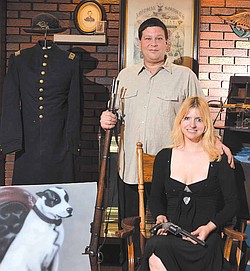
Marcus McLemore of Poland stands with his fi ancee, Bethany Ann Lettau, among their collection of Civil War memorabilia.
Remembering the Civil War
 Gallery
By JoAnn Jones
It was April 10, 1861, when Brig. Gen. P.G.T. Beauregard, commander of the Confederate Army in Charleston, S.C., demanded the surrender of the Union Army stronghold of Fort Sumter in the Charleston harbor.
After Major Robert Anderson, commanding officer at Fort Sumter, refused to do so, Confederate forces opened fire on the fort on April 12, thus beginning a four-year period like no other in American history — the American Civil War.
Commemoration of the 150th anniversary of the war begins Tuesday. To memorialize those who gave their lives, sesquicentennial events, reenactments and publications during the next four years will preserve the history of that time and introduce a new generation to the War Between the States.
Local historians and history buffs — especially those who can trace family heritage back to the war — are ready to share their knowledge with others.
“There are so many nooks and crannies in this war,” said Hugh Earnhart, professor emeritus and retired history department chairman at Youngstown State University. “It’s just so fascinating.”
“It’s a major watershed in American history,” he added. “America was never the same afterward.”
Earnhart, who taught at YSU for 33 years and is a co-founder of the Mahoning Valley Civil War Round Table, said the progress the United States made as a result of the war was phenomenal.
“It’s not popular to say,” Earnhart said with a grin, “but wars move civilization forward and force us to do things in order to win.” He cited things such as medical advances, food preparation, expansion of the railroad and establishment of a national banking system that came about after the war.
“Youngstown itself was nothing big until after the war,” he said.
A descendant of two men who fought in the 66th Ohio Regiment at Culp’s Hill at Gettysburg, Earnhart said he had a grade-school teacher and then a high-school teacher who made American history come alive for him.
“I learned about Grant and Sherman, and that did it,” he said. “The Civil War won out.”
Earnhart has a plethora of stories about the war, including one about women who masqueraded as men in order to fight.
When one of those soldiers died after the war, the family applied for a government pension.
“The doctor said, ‘You won’t believe this, folks,’ and the family didn’t get the pension,” he said.
The number of actual men, however, from Ohio and Western Pennsylvania who fought for the North was significant. When President Abraham Lincoln issued the call for volunteers to serve in the Union Army in 1861, the men of Ohio and Pennsylvania responded, according to Frank Barrett of Sebring, who has studied the war since he was 8.
Barrett, who can rattle off names, towns and dates relating to specific soldiers, said commemorating the war isn’t about “the large number of troops and moving vast armies.”
“This war was about the individual soldiers,” Barrett said. “It’s about the thousands of stories of the people who fought it.”
Barrett recalled the story of George W. Harlan of western Mahoning County, whose tombstone claims he was cited for bravery at the Battle of Chickamauga in Georgia in September 1863.
“It’s so ironic,” he said, “that Harlan returned home and was killed in a simple farming accident two years after that battle.”
Barrett added that the area in Mahoning and Columbiana counties is rich with stories about the war.
“Confederate Gen. John Morgan reached the farthest point north with land troops in 1863,” he said. “That was near West Point in Columbiana County.”
A stone marker now indicates the spot where Morgan surrendered his troops to Union Major George W. Rue on July 26. The marker, according to Ohio history, was erected by Will Thompson of East Liverpool in 1909.
Barrett is one of several volunteers who mow the grass at the Quaker Hill Cemetery in Sebring, a small cemetery that has grave markers for 29 Civil War veterans. He has spent time researching the lives of many of these soldiers, he said.
“A five-point star with G.A.R. [Grand Army Republic] on it shows they were in the war,” Barrett said. “Who they were, what they did … there’s a lot of neat history in this cemetery.”
Earnhart said the cemetery in Poland contains the graves of almost 200 Civil War veterans. But, he said, getting information on any veteran is very slow — and expensive.
“The pension file in Washington documents everything, and they’ll photograph the records,” he said, “but it costs about $60 a person.”
Marcus McLemore of Poland is a collector of Civil War memorabilia who keeps notebooks on individual soldiers that document not only their military service but many aspects of their lives.
Most hailed from Mahoning, Columbiana or Trumbull counties.
“My dad, James, was a collector,” McLemore said. “He was from Alabama, and he and my mother often got into heated discussions as to which was the right side — the Rebels or the Yankees.”
“We were watching a movie about the war when I was about 4 or 5,” he added. “Since I was interested, my mom, Doris, gave me a G.A.R. medal and some Confederate money, and that got me started.”
McLemore’s recent acquisition of the uniform and hat of Capt. Newell Carpenter of Sunbury, Ohio, of the 43rd Ohio Infantry, complements the many relics he said have been passed on to him by relatives.
He pointed out an article that appeared in a newspaper just after the war ended. The article urged soldiers to save clothes and relics for “children and grandchildren 100 years hence.” He has preserved a special case for the part of his collection that came directly from his relatives. He intends to pass his collection down to his son, Justin, 8, who already loves to visit Gettysburg and can recite the names of all the American presidents.
McLemore, too, can recite — story after story that relates to his collection.
“As a little child, I got an intense desire to know who my ancestors were and how they related to the Civil War,” he said.
One of these was Pvt. John C. Everhart, a coal miner from New Albany, near the Mahoning and Columbiana county line near what is now Salem.
“My great-great-grandmother was John Everhart’s sister,” he said. His notebook on Everhart documents most of Everhart’s life.
“I collect to honor these men and keep their memories alive,” he said, “not to glorify war. Some were my own flesh and blood.”
McLemore said it’s important for people who have Civil War relics to get them into a collector’s hand or into a museum so they aren’t lost forever. He also said it’s important to commemorate the events surrounding the war. Yet, he said the money for that will probably have to come from private merchants.
“This is like Ohio’s bicentennial, but without government help,” he said. “It will have to be a grassroots effort with people willing to impart their knowledge of the Civil War.” He himself has visited schools and local organizations to talk about the war.
Both Earnhart and Barrett also showed slight concern about the commemoration of the 150th anniversary of the Civil War, aka The War of Rebellion, aka The War of Northern Aggression.
“With the money crunch everywhere, not a whole lot is being done locally,” Earnhart said. “We’re hoping the Ohio Historical Society will do something. I’ve been kicking around doing some articles, talking about activities in the war for that particular month.”
Earnhart, who has impersonated Abraham Lincoln, his favorite subject from the Civil War period, said the Civil War Round Table has a monthly meeting at Antone’s in Boardman, where they bring in speakers to talk about different aspects of the war.
“We bring in all sorts of people,” he said. “At our next meeting, Keith Rocco, a Civil War artist, will talk about the themes in his paintings.”
Rocco’s presentation is scheduled for tomorrow.
Whether it’s a Secession Ball in the South at the end of March or a trip by local Civil War groups to the site of Antietam, where the single bloodiest day of the war took place, the four-year commemoration of America’s Civil War has begun.