 43
43

Budget deal benefits Obama, Boehner
ASSOCIATED PRESS
 Photo
Photo
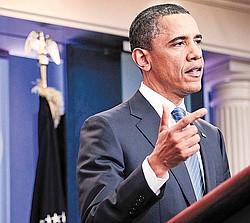
President Barack Obama speaks at the White House in Washington after meeting with House Speaker John Boehner, R-Ohio, and Senate Majority Leader Harry Reid, D-Nev., regarding the budget and possible government shutdown Thursday, April 7, 2011.
ASSOCIATED PRESS
Photo
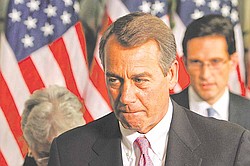
House Speaker John Boehner of Ohio, announces that an agreement to avert a government shutdown was reached at the U.S. Capitol in Washington, on Friday, April 8, 2011.
IFFY CUTS
Almost half of the budget cuts, some $18 billion, in the budget pact don’t involve cuts to agency operating accounts. They involve cuts to mandatory programs whose budgets run mostly on autopilot. Such cuts officially score as savings, but they often have little real impact in cutting the deficit. Some of them are listed below:
$2.5 billion in leftover highway money unavailable under current budget caps.
$500 million from reforms to the Pell Grant program.
$3.5 billion in unused Children’s Health Insurance Program funds.
$5 billion in “phantom” savings from capping payments from a Justice Department trust fund for crime victims.
$2.2 billion in cuts to subsidies for health-care cooperatives.
Source: AP
By PAUL WEST
Chicago Tribune
WASHINGTON
House Speaker John Boehner and congressional Republicans wrung a significant victory out of this weekend’s budget deal: They decisively shifted the focus in Washington away from spending and toward austerity, slashing government more steeply than expected and redeeming a pledge to voters in last year’s election.
President Barack Obama, by stepping in late to avoid a government shutdown, dodged a potentially devastating blow to his standing. That’s likely to preserve political gains he’s achieved since the midterm elections with independent voters who want government to work and don’t favor the deeply conservative Republican social agenda.
Democratic priorities were set back in the agreement to cut about $38 billion from this year’s budget, with many details yet to emerge. Obama, in his Saturday media address, hailed “the biggest annual spending cut in history” while acknowledging the cost: He had “to give ground” on important issues, he said, and accept “painful” cuts.
The president likened the compromise to his centrist-minded deal with Republicans in December, which disappointed many on the left by preserving huge tax breaks for the wealthiest Americans. That bargain was packed with additional stimulus, in the form of a payroll tax cut; this one symbolized the end of the Obama stimulus era.
But the tortuous wrangling over funding the government for less than six months offered little hope for easy resolution to the next — and far more consequential — fight: lifting the debt ceiling to keep the U.S. government from eventually defaulting on its obligations.
Boehner, R-Ohio, who emerged as the biggest winner in the initial round, strengthened his hand by wresting ever-larger concessions from the administration.
“Any time you can get significant cuts in a Democratic budget, in a government two-thirds controlled by Democrats, it’s a pretty significant victory,” said Whit Ayres, a Republican pollster.
At the same time, Boehner faces continued unrest on his right flank. Leaders in both parties say the country faces financial disaster if Washington fails to raise the debt limit. But many Republican lawmakers say they won’t vote to increase it without major budget concessions.
“Tea party”-backed conservatives decided not to shut down the government over abortion and environmental regulation this time.
But they also indicated that they were giving ground on the skirmish over 2011 spending in order to push for much more drastic cuts in the upcoming 2012 budget and debt-limit battles. And some will renew their calls to alter government policies on abortion, environment and health care.
House Budget Chairman Paul D. Ryan, R-Wis., unveiled an ambitious, and politically risky, spending blueprint last week that includes a sweeping overhaul of Medicare and Medicaid. Republicans will use it to appeal to voters worried about the budget deficit, while Democrats are warning that it would severely damage the social safety net.
Republican Rep. Michele Bachmann of Minnesota, a possible tea party presidential candidate, said she opposed this weekend’s budget deal because it failed to cut spending more deeply and allowed federal dollars to keep flowing to Planned Parenthood and implementation of the new health-care law — two of the GOP policy “riders” that Republicans gave up in negotiations.
More than two dozen Republican conservatives — and a larger number of liberal Democrats — also registered their opposition in a House roll-call vote early Saturday. The Senate approved the initial part of the deal in a voice vote, with at least one shout of “no” clearly audible. Republican Sen. Rand Paul of Kentucky, a tea party favorite, attacked the agreement for not doing more to reduce the budget deficit.
Obama signed a stopgap bill Saturday that will allow time to work out details of federal spending between now and Sept. 30, when the 2011 fiscal year ends. That measure will go before lawmakers midweek.
Democratic liberals weren’t mollified by Obama’s success in blocking Republicans from using the budget to push conservative social initiatives.
“The American people have been told the agreement contains both ’historic’ and ’painful’ cuts. The question will be: Painful for whom?” said Rep. George Miller, D-Calif., one of 42 Democrats who voted “no.” “Poor and middle-class families have already received more than their fair share of pain in this economy while the wealthy and special interests have paid no price.”
Maya MacGuineas, a prominent deficit hawk, said Republicans had dramatically changed Washington’s budget debate over the past month and improved the chances of putting longer-term fiscal restraints in place.
“Now we’re talking about real spending cuts, and I give them a tremendous amount of credit for that,” said MacGuineas, president of the bipartisan Committee for a Responsible Federal Budget.
A White House aide called the agreement the “first real test” of the new, divided government in Washington. But MacGuineas was sharply critical of the way the deal was reached, after weeks of political posturing and a closing burst of deal-making and brinksmanship.
A repeat in this spring’s fight over the debt ceiling could trigger drastic economic consequences, she said. Administration officials say the country will hit the $14.29 trillion debt limit next month. Unless the limit is lifted, the Treasury Department is unable to borrow or perform other functions.
“If we get even close to the last minute, we run a very serious risk of shaking up credit markets and doing severe damage to our economy,” she said.
She and others hope the new atmosphere of austerity nudges Obama to more aggressively address deficits. Christina Romer, former head of his Council of Economic Advisers, said she had been “pushing a little from the sidelines” for the president to get more involved.
“If he were out there talking about the long-term deficit problem and how it needs to be solved, he could convince the American people,” said Romer, who has returned to her post at the University of California, Berkeley. “I’d like to see him out there more.”
(Staff writer Peter Nicholas in Washington contributed to this report.)