 43
43

Abundant fuel connections mean it’s a gasoline world
AP
 Photo
Photo
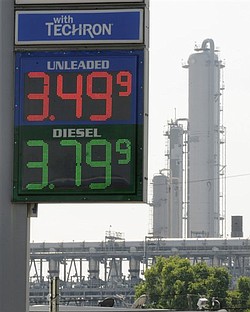
In this March 30, 2011 file photo, a Houston gas station displays its prices with a refinery stack in the background. Quick: What do these things have in common? Libyan leader Moammar Gadhafi. The Japanese earthquake and tsunami. Wall Street volatility. A cranky, even angry American populace. Answer: They all have something to do with gasoline. No matter what happens in the world today, just about everything seems to point back to fuel and the tricky politics that emerge when prices spike.
Associated Press
WASHINGTON
Quick: What do these things have in common? Libyan leader Moammar Gadhafi. The Japanese earthquake and tsunami. Wall Street volatility. A cranky, even angry American populace.
Answer: They all have something to do with gasoline. No matter what happens in the world today, just about everything points back to fuel and the tricky politics that emerge when prices spike.
Is it any wonder, then, that a recent Associated Press-GfK poll shows a correlation between the country’s more pessimistic outlook and rising gas prices?
The issue also has taken on greater importance to Americans. They rank it above subjects including Iraq, Afghanistan, immigration, terrorism and taxes. Last fall, 54 percent called gas prices a highly important issue to them personally, but 77 percent said that in the latest poll.
Many don’t expect relief from soaring gas costs anytime soon: Two-thirds say they expect the higher prices will cause financial hardship for them or their families in the next six months. That group includes more than a third who say gas-cost increases will cause serious financial hardship. And that is on top of a still-poor economy.
Most are changing the way they live. Three-fourths are cutting back on other expenses, two-thirds are driving less, half plan to vacation closer to home, and almost as many have thought seriously about buying a more fuel-efficient vehicle. Most also are bypassing the most convenient gas station to bargain-shop for the lowest prices.
GfK Roper Public Affairs and Corporate Communications conducted the poll from March 24-28. It involved landline and cellphone interviews with 1,001 adults nationwide and had a margin of sampling error of plus or minus 4.2 percentage points.
The underlying links between current events aren’t lost on President Barack Obama, and for good reason. Like death and taxes, this cycle is a certainty: Prices at the pump rise, the public’s mood falls, and the president gets punished.
Listen to him when he pressed recently for reducing the nation’s oil imports by one-third by 2025:
“Obviously, the situation in the Middle East implicates our energy security. The situation in Japan leads us to ask questions about our energy sources. In an economy that relies so heavily on oil, rising prices at the pump affect everybody,” Obama said. “Businesses see rising prices at the pump hurt their bottom line. Families feel the pinch when they fill up their tank. And for Americans that are already struggling to get by, a hike in gas prices really makes their lives that much harder. It hurts.”
Sure, that’s true. But there’s also much more to it. In an era in which globalization is a given, gas prices are the most obvious, most closely felt connection between the daily lives of Americans and the larger world.
“Whenever gasoline prices spike, there is enormous political consternation because it’s a highly invasive issue,” said Pietro Nivola, a senior fellow at the Brookings Institution who studies energy policy and American politics.
The poll indicated a disconnect between expectations and reality. Consumers on average said $2.36 per gallon was a fair price for gas, but the national average was $3.65 during the week the survey was taken.
Albert Mercado, a restaurant employee from Wallingford, Pa., is among those feeling more than just a pinch.
“When I swipe my card at the gas pump, it stops at $75 and I’m nowhere near full,” says the owner of a 2004 Ford Explorer, who lives outside Philadelphia. He now limits his travels to and from work, his son’s day care and their home. He saves rather than spends. He hasn’t visited his parents, who live a three-hour drive away in New York, for a long time.
And Mercado, 44, has little hope that costs will fall anytime soon.