 43
43

Wreckage, bodies found from ’09 Air France crash
ASSOCIATED PRESS
 Photo
Photo
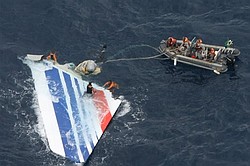
In this Monday, June 8, 2009 file photo released by Brazil's Air Force, Brazil's Navy sailors recover debris from the missing Air France Flight 447 in the Atlantic Ocean. Undersea robots have located a "large part" of an Air France jet that plunged into the Atlantic Ocean in 2009, but haven't yet found its black box flight recorders, French officials said Monday April 4, 2011. Victims' families cautiously welcomed the surprise announcement that search teams have located pieces of the plane, after nearly two years of fruitless efforts to determine what caused it to crash. Investigators have said without the recorders, the cause may never be determined.
Associated Press
PARIS
Specialists could start pulling up bodies and wreckage from an Air France plane found on the Atlantic Ocean floor within a month, after the stunning deep-water discovery raised new hope of determining the cause of the 2009 crash.
Investigators said Monday they still haven’t found the plane’s “black box” flight recorders, and it’s unclear whether they remain attached to the fuselage, or whether they’re even still intact after nearly two years in sandy depths of 2.4 miles.
All 228 people aboard the plane were killed when Flight 447, en route from Rio de Janeiro to Paris, slammed into the ocean northeast of Brazil on June 1, 2009, after running into an intense high- altitude thunderstorm. The cause of the crash — the worst in Air France’s history — remains unclear.
French officials said Monday that undersea robots have located bodies, motors and most of the Airbus jet in a fourth underwater search operation, after the last two search efforts turned up nothing. Investigators have said without the recorders, the cause of the crash may never be determined.
France’s air-accident- investigation agency, the BEA, showed photos of the wreckage — intact wheels from the plane’s landing gear, two engines dusted with silt, a panel of the fuselage with oval window openings.
The BEA did not show images of any bodies. French officials said identifiable bodies have been found and will be raised to the ocean surface but would not say how many or further comment out of respect for the victims’ families.
Fifty bodies were found during the first phase of the search, along with more than 600 pieces of the plane scattered on the sea. No bodies or debris have been found since, until now.
Victims’ families, who had pushed for continued search efforts despite the high cost, cautiously welcomed the surprise announcement.
BEA chief Jean-Paul Troadec told reporters Monday that he’s confident that engineers still can read the data and recordings in the black boxes, if they weren’t damaged in the crash.
The recorders should be in the rear of the fuselage, but it’s possible they were ejected in the shock of the crash, he said. If the black boxes are located, they may not need to bring up the rest of the plane, because the reason for the search was to help shed light on the reasons for the accident, he said.
The retrieval operation will be funded by France’s government and will cost a few million euros, French officials said Monday. The government has opened up a tender for companies that could carry out the actual retrieval.
The recovery could begin in three weeks to a month, said Nathalie Kosciusko-Morizet, France’s minister overseeing the environment and transport. She said “most” of the fuselage has been located.