 43
43

Southwest incident prompts FAA order
AP
 Photo
Photo
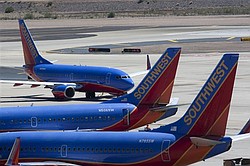
A Southwest Airlines jetliner maneuvers around the tarmac at Phoenix Sky Harbor International Airport on Monday, April 4, 2011 in Phoenix. The peeling away of a 5-foot-long hole recently on a Southwest Jet as the plane traveled at 35,000 feet raised questions about how vulnerable the world’s passenger air fleet is to similar cracks, and federal aviation officials were considering ordering more widespread inspections.
Associated Press
PHOENIX
Federal aviation officials readied an order Monday for emergency inspections on 80 U.S.-registered Boeing 737 jetliners like the one on which a piece of fuselage tore away more than 30,000 feet above Arizona last week.
The order, to be issued today, is aimed at finding weaknesses in the metal in the fuselage, but virtually all of the affected aircraft already will have been inspected by the time the order takes effect.
A 5-foot-long hole opened up in the roof of the Southwest Airlines plane soon after takeoff Friday from Phoenix, causing a loss of pressure and forcing pilots to make an emergency landing 125 miles to the southwest in Yuma, Ariz. No one was seriously hurt.
The safety directive applies to about 175 aircraft worldwide, including 80 planes registered in the U.S., the Federal Aviation Administration said. Of those 80, nearly all are operated by Southwest. Two belong to Alaska Airlines.
After the midair incident, Southwest grounded nearly 80 Boeing 737-300s for inspections. By Monday evening, 64 were cleared to return to the skies, and three were found with cracks similar to those found on the Arizona plane.
Friday’s incident, however, raised questions about the impact that frequent takeoffs and landings by short-haul carriers such as Southwest put on their aircraft and the adequacy of the inspections.
Since there had been no previous accidents or major incidents involving metal fatigue in that spot of the fuselage, Boeing maintenance procedures called only for a visual inspection by airlines.
But airlines, manufacturers and federal regulators have known since at least 1988 that planes can suffer microscopic fractures. That year, an 18-foot section of the upper cabin of an Aloha Airlines 737-200 separated in flight, sucking out a flight attendant.
The order is “certainly a step in the right direction,” said National Transportation Safety Board member Robert Sumwalt, who is in Yuma with the board’s accident-investigation team.
The FAA’s emergency order will require initial inspections using electromagnetic devices on some Boeing 737 aircraft in the -300, -400 and -500 series that have accumulated more than 30,000 takeoffs and landings, the agency said.
It will then require repetitive inspections at regular intervals.
Southwest’s jet was 15 years old and had logged 39,000 pressurization cycles, a measurement of the number of takeoffs and landings. That’s 7.2 cycles every day for every year it has been in service.