 43
43

Towns in Valley loaded in liquor
The Vindicator (Youngstown)
 Photo
Photo
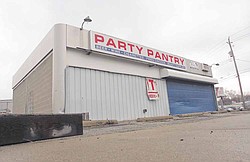
The Party Pantry at Canfield Road and Glenwood Avenue in Youngstown closed after voters in 2009 chose to prohibit beer, wine and mixed beverages to be sold at the store.
A Booming Business
Liquor is big business in Ohio. In 2009, the Division of Liquor Control posted record profits — $224.2 million. In the last calendar year, the total dollar sales of spirituous liquor, containing more than 21 percent alcohol, grew by $19 million to $753.7 million.
Gov. John Kasich has proposed to lease the state’s liquor wholesaling functions to JobsOhio, the new private nonprofit development arm of state government, headed by the governor and a board he appoints.
JobsOhio will not take over issuing liquor permits to bars and restaurants and other places where alcohol is sold and consumed on the premises.
The Department of Commerce Division of Liquor Control will continue to issue liquor permits and enforce licensing.
No changes have been proposed to the options of dealing with a liquor-permit premise. Those options are a local-option election to repeal a license; padlock procedures to close a nuisance establishment; and legal legislative authority objections to the annual renewal of a liquor permit.
Source: Ohio Department of Commerce
Youngstown exceeds its permit quota by 24
YOUNGSTOWN
The city has enough liquor permits for an area with more than 96,000 residents.
But as the 2010 census shows, the population is only 66,982.
Youngstown has 24 more liquor licenses issued than it should based on the 2010 population — more over quota than any other municipality in Mahoning and Trumbull counties, according to data from the Division of Liquor Control in the Ohio Department of Commerce.
Most of the overages are in the Restaurant/Night Club permit classes, which are beer, wine and mixed beverages only for on-premises consumption or in sealed containers for carry out.
Youngstown isn’t the only area in Mahoning County over quota. Coitsville and Milton townships – with 15 and 13, respectively – have more liquor permits issued than their current population allows. In Trumbull County, Brookfield Township has the most permits over quota with 12, followed by Warren Township with seven.
However, the state cannot take away a license based solely on quota changes.
“If the population loses numbers, the division does not go back and take away a permit of the business,” said Matt Mullins, spokesman for the Division of Liquor Control.
It can be a long process to get a liquor permit revoked.
The local legislative body, in this case Youngstown City Council, has the ability to object to renewal and provide grounds for which the division can deny or reject the permit, Mullins said.
“The objecting party bears the burden of proof to present that one of those grounds [for rejection] exists or would exist if we would renew it,” he said.
That’s only the first step. The business could then appeal the decision to the Ohio Liquor Control Commission, and the commission’s decision can be appealed to Franklin County Court of Common Pleas, he explained.
The process can be long and frustrating for residents such as Val Goncalves, who has lived in Brier Hill for 26 years.
“We’re just so tired of it,” Goncalves said.
She and other residents have long been concerned about Brothers Belmont Drive Thru on Belmont Avenue, and city council filed an objection to its liquor permit renewal last year.
“We do have proof of loitering, loud noise, trash and kids walking up to the window. There’s nothing healthy coming out of that store,” Goncalves said.
Mayor Jay Williams said city government officials also are weary of the process in general.
“Sometimes it’s frustrating. We will object, and we’ve found the Division of Liquor Control will still provide a renewal. ... These are local communities objecting based on real-life scenarios. ... We’ve requested a more comprehensive review from the state and the understanding that when we object [to renewal], we are objecting for very valid reasons,” Williams said.
Goncalves and others in her neighborhood block watch “Love Your Neighbor” were disappointed when a hearing with a Liquor Control Commission representative about Brothers was canceled last week. It has been rescheduled for May 2.
“We were willing to go to [the business] and say, ‘Look, clean up this and don’t let [kids] walk up to the drive-through,’ ” she said, discussing the disappointment with the postponed meeting.
“People were quite upset, and now they want to put it on the ballot and close the store,” she said.
Atty. Neal Atway, who represents Brothers and has more than 20 years of legal experience on liquor permits, said the hearing will be a chance to see if the business can alleviate residents’ concerns.
“Residents sometimes say there’s too much crime and the store’s contributing to that, and we say there’s crime everywhere in the city, and it’s not our job as a business owner” to control it, Atway said.
“We can make sure [the stores] have adequate lighting and no loitering and the parking lot is clean, but we can’t stop the crime,” he added.
Atway said many liquor-permit holders have been in the city for a decade or more and are trying “to make an honest living.” He also noted that to be competitive in the convenience-store business, owners sell beer and wine because the state sets minimum prices for alcohol.
“No one around you can sell it for less than the state minimum. That’s why they have to have beer and wine sales, because every penny counts in that type of business. That’s the reason if you take away beer and wine, you take away their livelihood,” he said.
By putting it on the ballot, Goncalves means giving residents the choice to vote the precinct dry, specifically banning permits of carry-out stores. If that does happen, Brothers may have a similar fate as the Party Pantry on Glenwood Avenue.
In May 2009, voters chose to no longer permit Party Pantry to sell beer, wine and mixed beverages. At the time, co-owner Zuhair Sarsour said the decision would kill his business.
It did. The store stands boarded up today.
Residents do want to work with local businesses, said Tammy Thomas, a community organizer with the Mahoning Valley Organizing Collaborative.
Thomas has met with Goncalves and other area block watches on the newly launched Healthy Neighborhood Store Initiative, which will have an information session for the public at 6 p.m. April 28 at the main library on Wick Avenue.
“We were trying not to just focus on negative parts, but also how to get foods in the neighborhood. We’ve tried to move away from calling them corner stores,” Thomas said.
She added that residents are looking for stores to partner with them and to sign community agreements, which essentially state that the store will be a “good neighbor.”
Residents will share a part, as well, helping with “market make-overs” that spruce up the store and surveying what people would buy.
“We don’t want that store owner to put his neck on the line and buy Brussels sprouts if no one will buy them,” Thomas said.
And the initiative is not a temperance movement, she added.
“We’re not telling people not to drink. We’re all adults. It’s not about that. We’re saying that we need options. There’s an unfair balance here,” she said.