 43
43

Science students can experiment in new labs
 Photo
Photo
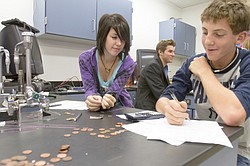
Junior Amanda Carlisle and sophmore, Austin Beil work on properly using measuring instruments to directly determine the thickness of a penny and indirectly determine the thickness of aluminum foil during a chemistry class at Poland High School on Tuesday afternoon.
 Photo
Photo
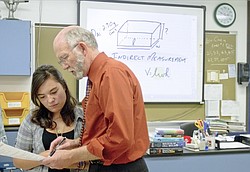
The Vindicator | Geoffrey Hauschild.Instructional drawings are projected with the aid of a new smartboard over the shoulder of chemistry teacher, William Snyder, as he helps junior, Desiree Zepeda, with a question during a chemistry class at Poland High School Tuesday afternoon.
By Ashley Luthern
How thick is a piece of aluminum foil?
That’s the question for Poland Seminary High School chemistry students.
They get to ponder their answers in a brand-new laboratory.
Renovations to lab spaces in all five of the high school science rooms were finished this summer, having been completed in phases. Lab surfaces were replaced, and extra storage space for equipment was added.
The project began in 2006, and the renovations cost was about $56,000 for each lab, said Superintendent Robert Zorn.
The money was provided through savings from the retire-rehire program — specifically for the superintendent, Zorn said.
“When the board brought me back, I wanted the money to go to something specific instead of the general fund,” he said.
A board member suggested renovating the high school labs, which had remained unchanged since 1971 when the high school was built. Many of the wooden lab drawers no longer opened, shelves were broken, and the insides of the cabinets were falling apart.
“Science labs get dated, and 39 years later, those labs needed updated,” Zorn said. “If you look at education today, two of the nation’s priorities are science and math. In the global economy, the nations at the top will be leaders in science and math.”
All five science classrooms also are equipped with projectors and SMART Boards, said William Snyder, who teaches chemistry at PSHS and Youngstown State University.
“There’s more storage and organization. It tells the students that science is a priority,” Snyder said. “It really modernized the lab.”
The first general- chemistry lab didn’t involve any chemicals, but rather gave students a foundation of how to properly measure items — such as foil — and find unknown values using indirect measurement.
“I was excited to get in the lab,” said sophomore Abby Bagezda.
So how thick is a piece of aluminium foil? On average, less than 0.2 millimeter.
In inches, that figures out to be 0.0079 inch.
A millimeter is about as thick as an ordinary paper clip.