 43
43

Simple physics explains fair riders’ tingly feeling
 Photo
Photo
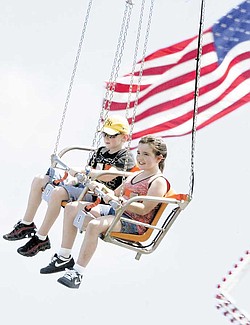
Nick Fromel, 9, of Greenford and Jamie Andrews, 10, of Austintown enjoy riding Vertigo, a swing ride that debuted Wednesday at the Canfield Fair.
- 164th Canfield Fair
-
- More for Lesses
- Digital cameras increase entries
- SCHEDULE OF EVENTS Through Monday
- King, queen credit 4-H for skills
- Family man cuts ribbon to open fair
- Memorable ride
- Gretchen Wilson will get the party started
- Dierks Bentley takes risk on bluegrass-flavored CD
- His peppers are bigger than life
- Fair Digest || Alternate fair routes
- Health board inspects all the food at the fair
- Ride Safety Division at Canfield Fair
By Ashley Luthern
CANFIELD
Swinging 85 feet above the Canfield Fairgrounds, Nick Fromel lost his hat.
Fromel, 9, of Greenford, was riding Vertigo, a swing ride that debuted Wednesday at the fair.
“It makes my stomach feel tingly,” he said, before heading back for a second ride.
The tingly feeling that creeps up on riders of many amusement attractions can be explained by simple physics.
As the chains hang straight down, the rider’s body is also straight down. When it moves, the rider’s body swings outward, said Richard Zitto, retired physics professor at Youngstown State University. Zitto also has written a book about the physics of Geauga Lake rides.
“That acceleration is the centripetal acceleration toward the center of the circle,” Zitto said. “The people feel like they’re being shoved outward, and they’re not really being shoved outward.”
In order for the ride to get to the equilibrium point based on its rotational speed, the circle gets wider, and the centripetal acceleration gets greater, he said.
“Then your body gets to the point where the system is in equilibrium, so that the force is acting inward, and what you feel is acting outward is giving you the one G of centripetal acceleration,” Zitto said. A G-force is short for gravitational force, which is actually a measure of acceleration.
Vertigo pairs riders and slowly starts swinging them at a 28-degree angle, while the swing base moves higher into the air.
But it’s not just swings giving thrills. Even the Ferris wheel can make a stomach flip: Just ask Riley, 8, and Cameron, 7, Adamowicz of Boardman.
“When we get stuck at the top, that’s the best part,” Cameron said.
“Going in circles and then getting to the top is the best,” Riley clarified.
At the bottom of the Ferris wheel, people feel twice as heavy, and at the top of the wheel, they feel weightless. Both sensations can be explained by forces, Zitto said.
“If the ride rotation is just the right speed, you’re going to the top, and you’re feeling weightless. The centripetal force and your weight are the same thing,” he said.
“Your weight is acting down so it becomes the centripetal force, so the seat doesn’t have to push against you. At the bottom, the centripetal force is provided by the seat, and the seat has to support your weight. You end up with two forces, and you feel twice as heavy as you did at the top.”
Cameron and Riley said they didn’t mind the sensation as their seat on the Ferris wheel swept down from its peak during its rotation.
“When you come down, it’s like a coaster at the top of a hill; you don’t see the track,” Zitto said.
“You felt like you were floating above the seat, and now you feel like you’re going to fall out. That’s why everybody seems to grab the bars when they start to come down; it’s a sensory thing.”
If people take their pulse before a ride and immediately after, they’ll find a significant difference, he said.
“Your pulse quickens when you’re in a fear factor,” Zitto said. “Rides are made for you to think about them and how your body reacts to them.”