 43
43

Youngstown State’s no-huddle offense is sign of the times
North Dakota State 34 - YSU 29
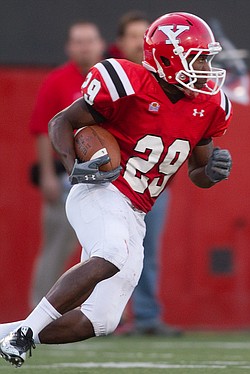
 Gallery
By Joe Scalzo
YOUNGSTOWN
As a high school quarterback at Dayton Chaminade-Julienne, Kurt Hess had to run to the sideline after every play to get the next play from his coach.
“It would get tight [time-wise],” said Hess, now a redshirt freshman starter at Youngstown State University. “My parents didn’t like it either. They’d ask, ‘Why do you have to go to the sideline every time?’”
Did he ever get tired?
“A little bit,” he said. “But I’m still a quarterback. I don’t move a lot anyway, at least I try not to.
“I’m better when I don’t.”
Fortunately for Hess, it’s no longer an issue. Like a lot of teams across the country, both at the college and high school level, the Penguins run a no-huddle offense in which the plays are signaled in from the sidelines.
Before each play, wide receivers coach Phil Longo and backup QB Marc Kanetsky stand side-by-side signaling in the play, which comes from offensive coordinator Shane Montgomery in the press box. (To discourage teams from stealing signs, one of them is a decoy.)
The two go through a fairly long progression of signs, which indicate the personnel (a four-receiver, one-running back set, for instance), formation (anything from an I-formation to empty backfield spread), play and protection scheme.
Often, after lining up, the players will then look back to the sidelines to see if the call changed based on the defensive alignment.
“We want to have the ability to play as fast as we can without wearing guys out,” said Montgomery, who brought the strategy over from his days as a head coach and offensive coordinator at Miami (Ohio). “It used to be, you’d huddle every time and when you got into a two-minute situation, it was almost chaos because you never did that.
“The good thing now is we’re basically in a two-minute situation all the time.”
For decades, coaches sent in plays using a runner, who inevitably had to replace someone in the 11-man lineup. (Many teams still do this.)
The advantage was the play would get to the huddle quickly and (presumably) with no confusion.
And some teams who use the no-huddle, signal approach will still use other methods. (Poland High, for instance, uses a combination of signals and QB Colin Reardon running to the sideline.)
“[Signaling] has kind of become the craze,” said Montgomery, who used the runner approach when he was a college quarterback at North Carolina State. “The thing we’re running 10 years ago goes out for awhile and comes back in.”
Signaling has its downsides, of course. For one, it takes awhile to learn everything. Hess said it took him most of spring camp to master and WR Juilian Harrell, who transferred from Miami (Ohio) in the summer, had to play catch-up during fall camp.
What made it more challenging for Harrell was the fact that he had to learn all of the receiver positions, something YSU does so it won’t have to move wideouts from one side of the field to the other.
“I like it,” said Harrell. “For one, I get to play different positions. I’m not stuck in one spot. And two, it’s more exciting than having to come back to the huddle every time.
“Plus it keeps the defense on its toes. They have to hurry up a little bit, too, because they’re not sure when we’re going to snap the ball.”
Consequently, defensive teams are limited both in their substitutions and their coaches’ ability to make calls. (Which is why many teams, including the Penguins, also use defensive signals.)
Of course, there’s one other offensive downside. The huddle has taken on mythological status over the years, both because it gives the quarterback a chance to make a moving speech to rally his team in a tight spot (which reporters will then write about afterward, whether it made a difference or not) and gives the receivers a chance to remind that quarterback that they’re open on every play.
“We can still do that,” said Harrell, laughing. “If I have something to say to Kurt, I can just walk over or he’ll walk over to me. It’s not a problem.”
What is a problem is coming up with signs. Montgomery and his staff will come up with some, but he often turns to his players for suggestions.
(Freshman Gannon Hulea was the best at this in the summer; alas, he was moved to safety late in camp.)
“You just come up with anything,” Montgomery said. “We laugh because the coaches, we come up with things we think are reasonable for us and the players are always like, ‘How did you come up with that?’ And if we let the players do it, they come up with things we wouldn’t think up.”
Not surprisingly, nobody wanted to give examples from this year’s offense. But at Miami, Montgomery had a play called “Viking,” which consisted of four receivers running vertical routes up the field. To call it, he mimed the horns on a viking helmet. And last year’s YSU offense, which also used signals, would mime driving a car with one hand, indicating the need to pick up the tempo.
“The biggest thing is, whatever you call it, whatever you signal, whatever you practice, they’re going to learn, whether it makes sense or not,” Montgomery said. “Sometimes things that don’t make any sense they remember more because it’s just off the wall.
“Consequently, we don’t have a lot of mental mistakes because they practice no-huddle every day. It becomes second nature.”