 43
43

What makes special teams special?
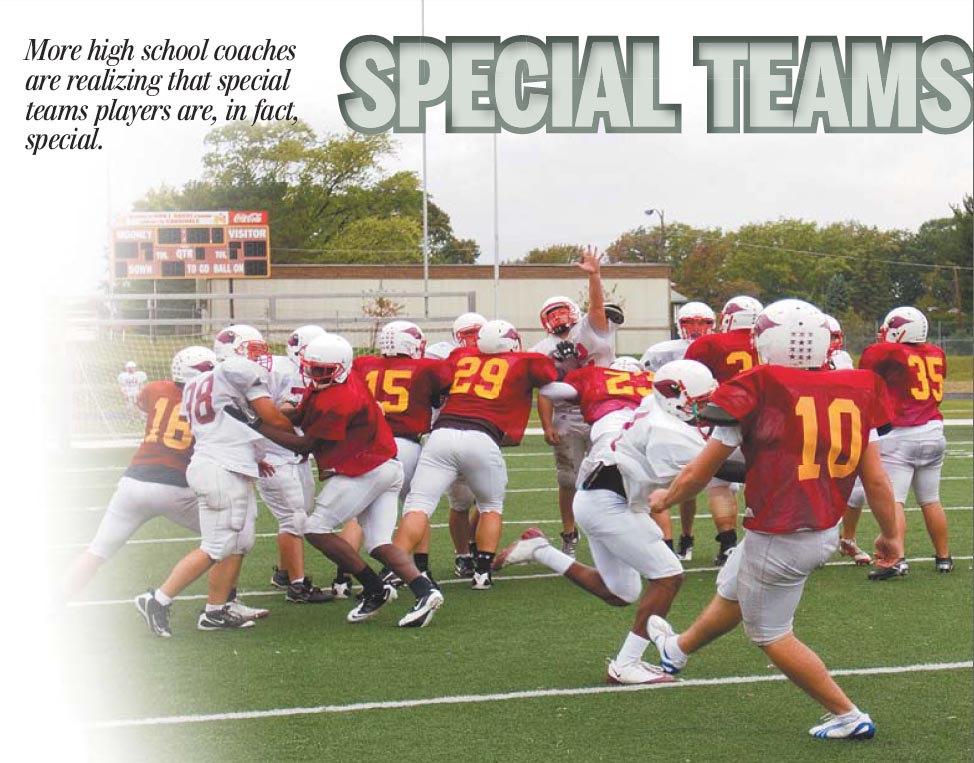

By JON MOFFETT
jmoffett@vindy.com
Youngstown
All it takes is a missed extra point, a blocked punt or an opponent’s long kickoff return to boil a coach’s blood.
Special teams are that third, unsexy part of football. But more and more teams are finding the connection between a strong unit and success.
And more high school coaches are realizing these players are, in fact, special.
“It is a phase of the game that a lot of people like to give lip service to,” said Cardinal Mooney coach P.J. Fecko. “You think about how field goals and extra points are scoring plays, but the battle of field position is crucial; whether it is having a punter that can propel the ball downfield and swing field position for you, or having a returner who has the ability to [gain field position].”
It’s not uncommon to see any player kicking off or attempting field goals and extra points for a high school football team. Many coaches believe that if a kid can get the ball into the air, he can act as the de facto kicker.
Why?
It’s just how it’s been done. And high schools aren’t alone.
Soccer-style kicking was introduced to the sport at the professional level in the early 1960s. The Buffalo Bills signed Hungarian immigrant Pete Gogolak to handle the placekicking duties in 1964. He was so successful with his style — which gave him more velocity and accuracy than traditional straight-on kicks — that his style was imitated. And it stuck.
Prior to that, coaches would use the mentality of a kicker must simply kick the ball and hope for the best. The Cleveland Browns championship teams of the 1950s and 1960s were led in part by Lou “The Toe” Groza.
Groza was inducted into the Pro Football Hall of Fame as an offensive lineman. But his legacy, as evidenced by his nickname, is forever paired with his work as a special-teamer.
Today, many high school kickers are also soccer players. Or, in the case of Mooney’s A.J. Fox, were soccer players for a number of years.
Fox handles three vital roles for the Cardinals’ special teams unit. He kicks the field goals and extra points, handles the kickoffs — which are much different, Fecko said — and is their punter. Fox got his start in soccer, but soon gained a passion for football.
“I’ve kicked since my freshman year, but I got serious about it last year,” Fox said. “I did enjoy soccer my whole life, and in my eighth-grade year, my dad had a team and me and my friends all played.”
Now a senior, Fox said he made the choice to switch to football when he decided to attend Mooney. He said he and his fellow kickers revel in the idea that they are now becoming more of a focus, rather than blending into the background.
“Last year when we played Poland, they kept doing onside kicks, and I think they recovered two of them,” Fox said. “Those are huge momentum swings for a team and show how important special teams can be. I think a lot of schools are seeing the importance of those kinds of plays.”
On non-scoring plays, momentum is the biggest thing a good special teams play can affect, Fecko said.
“Not only can you gain of out points, but you also steal all of the momentum and the excitement,” Fecko said of a good special teams play. “It’s an energy boost for your team.
“Special-teams plays have the ability to be momentum changers, good or bad. Say you miss an extra point. Sure that one point is crucial, but the momentum lost is crucial, too.”
But how does a coach go about finding a good specialist? Fox and Fecko had different ideas.
“All the coaches I’ve seen and talked to, they say the biggest thing they look for is a leg when they first see a kicker, because you can’t teach that; you can’t teach someone how to kick it far,” Fox said. “You can teach consistency and other things, but not leg strength.”
Fox knows a little something about leg strength. He’s kicked a 47-yard field goal in his career, but boasts he could make a 55-yarder if he was in position to do so.
“I love the one-play series, and I love going out there with an adrenaline rush and having the chance to win the game for my team,” Fox said.
Fecko said if the situation arose, he’d be more than comfortable to send Fox out for the try. His stance on a good specialist, however, was a little more analytical.
“I think they’re broken down into three different people, but they could be the same guy” Fecko said. He broke it down as follows:
Extra Point & Field goal Kicker
“An extra point/field goal guy has to have accuracy and a little bit of height on his ball,” Fecko said. “He doesn’t have to kick it very far, he just has to be accurate.”
Kickoff Specialist
“With the kickoff guy, now you’re looking for leg strength,” he said. “You’re looking for height, and lastly, maybe ball placement.”
Punter
“Your punter, believe it or not, the first thing you’ve got to do is find guys who can catch the ball,” he said. “That’s an understated part of the deal. Those snaps are not always good, it could be windy or wet. I need someone who can field the ball.
“Then you look at hangtime. I want a guy who has an aggressive mentality as a punter. I don’t want a guy who, when you get down and you’re trying to pin someone inside the 10, shanks it because he’s afraid to kick it into the end zone.
“The height is important, maybe more so than the yardage. Consistency is important, too.”
Fecko added that a team is lucky if one player, like Fox, is able to handle all three duties. Otherwise, the positions are divided up by their skills.
Their special skills.