 43
43

YSU plotting course to improve campus travel
 Photo
Photo
By Denise Dick
YOUNGSTOWN
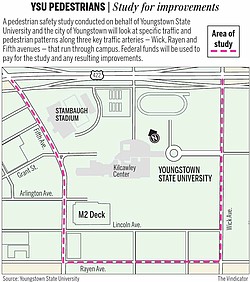
A study under way of streets around the Youngstown State University campus aims to improve safety and efficiency for all modes of travel.
Two public workshops are planned for Tuesday to provide information and gather input about the area, the study, the problems and potential solutions.
The first runs from 10 a.m. to noon in the Chestnut Room of Kilcawley Center at YSU with a presentation at 10:30 a.m.
The second is from 4:30 to 6:30 p.m. at the offices of Eastgate Regional Council of Governments in the City Centre One Building on East Federal Street. A presentation is set for 5 p.m.
MS Consultants and Behnke Associates of Cleveland are conducting the study, which is funded by a $1.9 million federal grant.
“We have been gathering information on traffic volume, signal timing, pedestrian traffic, and we’ve compiled that,” said Valerie Croasman of MS Consultants.
Next week’s workshops will allow the consultant to explain the study as well as gather feedback from the public.
In the spring, the company will return to offer alternatives for solutions to identified problems.
Hunter Morrison, YSU’s director of campus planning and community development, said Youngstown is administering the grant as the streets included are municipal streets. But those streets are within the campus boundaries.
The study area is bounded by Fifth Avenue to the west, Rayen Avenue to the south, Wick Avenue to the east and U.S. Route 422 to the north.
The study will identify short- and long-term options for improvements.
It will consider roadway and intersection design, traffic control, parking locations, wayfinding and disability accommodations.
It also will include all modes of transportation: pedestrian and bicycle facilities, crossing locations and connectivity and transit stop locations and connectivity.
“A subgoal is we’re working with Behnke Associates to make sure we’re merging the solutions with plans for what the campus looks like,” Croasman said, referring to aesthetic considerations for the desired vision of the campus and its landscaping plan.