 43
43

Veterans Treatment Court to handle unique problems
The Vindicator ( Youngstown)
 Photo
Photo
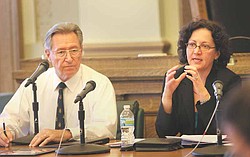
ROBERT K. YOSAY | THE VINDICATOR Judge Robert P. Milich of Youngstown Municipal Court, a retired Air Force lieutenant colonel, and Melissa Knopp of the Ohio Supreme Court’s Specialized Docket Section, were among a group of people who met Tuesday in Youngstown City Council chambers to continue planning for the Jan. 11 opening of the Youngstown Veterans Treatment Court.
YOUNGSTOWN
Treatment court
Youngstown Municipal Court, under the auspices of Judge Robert P Milich, is on the ground floor of a national movement toward Veterans Treatment Courts. Here are some details and fast facts:
The first session of the Youngstown Veterans Treatment Court is scheduled for Jan. 11.
The first Veterans Treatment Court began in 2004 in Anchorage, Alaska, when a drug court began offering special services to veterans.
In January 2008, the Buffalo Veterans Treatment Court was the first court in the nation to offer a veterans-only court docket.
Sources: Youngstown Municipal Court/National Association of Drug Court Professionals
YOUNGSTOWN
Military veterans need a Veterans Treatment Court because their problems are unique, says a court proponent.
“Some of them have seen their buddies blown up,” said Youngstown Municipal Judge Robert P. Milich, who is spearheading the creation of a Veterans Treatment Court here.
The Youngstown Veterans Court is scheduled for its first session Jan. 11, said Judge Milich, who, with other Veterans Court team members, met Tuesday in city council chambers to continue planning for the court’s formation.
The Veterans Court is similar in concept to Municipal Court’s Drug and Mental Health Courts in that nonviolent offenders are given the option of treatment in lieu of jail. If they do not follow the treatment plan, they can be dropped from the program and sent to jail.
But though veterans can have drug and mental health problems that cause them to run afoul of the law, having been in the military adds another layer of experience that needs to be taken into account, Judge Milich said.
The Veterans Court also differs from the Drug and Mental-Health courts in that the Department of Veterans Affairs provides treatment; and it involves more of the Alcoholics Anonymous concept in that there will be volunteer mentors to assist veterans in the judicial system.
Judge Milich said he also has personal reasons for creating the Veterans Court.
Youngstown’s Ryan A. Yurchison Mentor Group is named in honor of the son of Cheryl DeBow, a municipal- court probation officer, who has supported the idea of a local veterans court for many years, he said.
DeBow is the mother of two Army combat veterans: Michael J. Yurchison and Ryan A. Yurchison. Ryan was deployed to Kuwait in November 2005 and then to Iraq in June 2006.
He was wounded while on guard duty Sept. 14, 2006, when a dump truck filled with sand and explosives exploded near the front gate, killing three and wounding 43. He returned to duty in a week and was honorably discharged Feb. 16, 2007. He died May 22 this year as the result of the effects of the war, Judge Milich said.
Veterans interested in serving as a volunteer in the mentor program, headed by John P. Brown III, past national commander of AMVETS, should contact Judge Milich at 330-742-8855.
The judge is a retired Air Force lieutenant colonel who served four years on active duty and 24 years at the Youngstown Air Reserve Station in Vienna. As administrator of the 910th Airlift Wing’s Medical Squadron, he served in Vietnam and Operation Desert Storm.
“I’ve seen firsthand the effects of war,” he said.
The judge said one of the basic messages the team came back with from training in Buffalo, N.Y., in October was that the court has to be a team effort.
“Working together we have a much better opportunity to succeed,” Judge Milich said.