 43
43

Is WRTA off track?
 Video
Video
 Photo
Photo
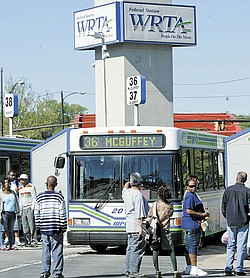
Riders wait to board a bus at the Western Reserve Transit Authority at its station in downtown Youngstown. Some have criticized WRTA for allowing the downtown terminal to deteriorate as it spends $1.2 million to expand its administrative offices.
 Photo
Photo
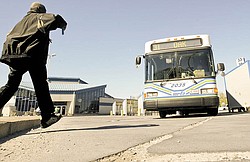
A rider hurries to board a WRTA bus in downtown Youngstown.
As ridership accelerates, downtown bus terminal deteriorates
By Doug Livingston
TheNewsOutlet.org
YOUNGSTOWN
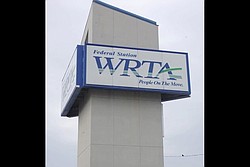
Inside downtown’s Federal Station bus terminal, a large brown spot outlines several ceiling tiles that have fallen from water damage.
A metal bar, once holding a tabletop, sticks up from the tile floor.
In the bathrooms, a foul odor permeates the graffiti-covered stalls.
Outside, across the pothole-ridden parking lot, Youngstown resident Sachi Johnson waits for her bus under a glass-paneled enclosure. She wonders what Greyhound riders passing through Youngstown think of the city, viewed through the rust-stained windows of the Federal Street facility.
“They think that Youngstown is dirty,” she figures.
Johnson is one of more than 1 million people in the Mahoning Valley who will use the Western Reserve Transit Authority’s bus services this year.
WRTA was one of the Valley’s first agencies last year to secure federal stimulus money — $3.5 million.
Despite a crumbling central terminal, WRTA officials instead decided to expand administration offices on Mahoning Avenue for a price of $1.2 million. The move sparked criticism from local residents, and it continues with riders like Johnson.
“We’re not proud of it,” James Ferraro, WRTA executive director, said of the facility that opened in 1985.
Ferraro argues that improving the administrative office was vital to improving countywide service, which will reach more voters and taxpayers than improving Federal Station.
Ferraro said he doesn’t think people from Sebring or Green Township care about Federal Station.
“But I can tell you this much, that if their family and their neighbors aren’t benefiting [from the recently expanded WRTA service] then they’re gonna say, ‘Why should I support [the sales tax] next time?’” Ferraro said.
In November 2008, WRTA moved from a property tax to a .25-cent sales tax. The sales tax is up for renewal in 2013.
Conditions at Federal Station have worsened over the years.
A total of $80,500 has been spent on the bathrooms over three restorations. The parking lot has been paved three times as well, totaling more than $425,000. A recent assessment of the parking lot, last repaired in 2005, calls for an additional $40,000 to repair.
One potential solution: Eliminate the terminal facility altogether, leaving a small area for Greyhound passengers. The rest of the property on West Federal Street would be open-air shelters for local riders.
Many riders oppose this idea, however.
“I don’t really like the idea of downsizing the building,” Youngstown resident Gene Shirilla, 55, says. “Winters can be harsh, and I don’t think anyone wants to stand outside.”
But Ferraro said people who ride the buses really don’t come into Federal Station. He estimates 16 percent of riders, or 172,000, will pass through facility this year.
The main offices on Mahoning Avenue had new needs, however.
September route expansions added 25 workers, bringing total staff to 83. New positions include 20 drivers, four maintenance staff and one telephone clerk. Two additional office positions are expected after the administrative building is completed.
“The [Mahoning] facility as it was wouldn’t permit us to bring on new people,” Ferraro explained. “There just wasn’t enough room.”
Officials also noted that conditions within the administrative building were inadequate, citing roof leaks, poor lighting and the presence of exhaust fumes.
The project, planned since 2005, is on schedule for completion in mid-June. The project includes the addition of a 960-square-foot area on the second floor to house a new board/conference room and an elevator to meet Americans with Disabilities Act standards.
Outside the complex, a sign placed at the request of board members touts this work as part of the American Recovery and Reinvestment Act — not the new sales tax.
The stimulus package provided $3.5 million for several capital projects — $2.1 million for the administrative office expansion, $990,000 for 12 buses and five minivans, $352,000 for operating assistance, $72,000 for surveillance cameras and $15,000 for bus shelters.
So far on the expansion, only $1.2 million has been contracted, leaving a surplus of about $1 million. WRTA will use the excess funds for future expenditures such as replacement and maintenance of buses.
Before the construction of Federal Station, WRTA riders would wander Commerce Street waiting for their shuttle. The transit authority was proud to offer riders an indoor facility to get them out of the cold. But the cost of maintaining the station has become a concern.
“Hindsight says that it was a little more costly than we expected,” Ferraro admits.
Federal Station originally cost $1.6 million. Since then, WRTA has spent $728,424 on repairs, mostly paving and exterior construction.
Some repairs have been futile. Ferraro noted that vandals removed the water fountain and urinals from the walls four times each.
Any renovations to the building will not last long, he added.
Still, something has to be done.
WRTA is tentatively seeking $6 million through a second round of federal stimulus funds to address these concerns. Officials have applied for these funds and are awaiting a response from the federal government.
Those stimulus funds call for a $1.5 million renovation for Federal Station. The project is third on the priority list, behind a request for nearly $352,000 for operating assistance and $1.1 million to expand storage buildings to house the 12 buses purchased through the first round of stimulus spending.
Ferraro, however, is uncertain sufficient funds will be secured to accomplish every goal.
“We’re hoping to get close to $3 million,” he said. “I think that Federal Station needs too much work, so we’d probably have to do that first and just go without storing [vehicles] indoors.”
The transit authority also is considering either decreasing the size of Federal Station or tearing the building down, leaving a ticket office for Greyhound riders and outdoor shelters for local riders.
“I don’t believe they should get rid of it,” said Youngstown resident Bob Campbell, 57.
He uses a walker to navigate the parking lot. His bus waits could last as long as an hour. Campbell argues that Federal Station provides a safe shelter from the elements, bus traffic and occasional car that takes a wrong turn into the parking lot.
“I don’t want to be standing outside when it gets cold,” rider Tyeashea Taltoan says. “They should think about other people’s well-being.”
Councilwoman Annie Gillam, D-1st, said extreme Youngstown winters require a place where people can sit inside. She says she will contact the transit authority to discuss the station’s future.
Mayor Jay Williams called the terminal a significant presence downtown. He said he wants to be part of any decision on its future, and that he intends to stay in contact with WRTA.
kThe NewsOutlet is a joint media venture by student and professional journalists and is a collaboration of Youngstown State University, WYSU Radio and The Vindicator.