 43
43

Beauty in the eye of the beholder

 Photo
Photo
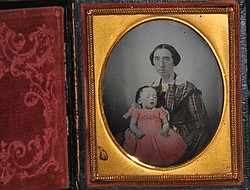
Neighbors | Shaiyla Hakeem .Poland resident Steve DeGenaro has had more than 100 postmortem and memorial photographs accepted into the UCR/California Museum of Photography. He began collecting the memorial photos in the 1980s.
 Photo
Photo
Neighbors | Shaiyla Hakeem .Poland's Steve DeGenaro donated more than a hundred memorial and postmortem photos from his private collection. He says the photos have both historical and artistic value.
By SHAIYLA HAKEEM
Hobbyists collect items such as stamps, coins, buttons and in this case, postmortem photographs.
Poland resident Steve DeGenaro has donated more than 100 postmortem photographs to the UCR/California Museum of Photography. He knew that postmortem, or memorial, photos were something that he wanted to invest time and money into from the first time he laid eyes on one.
“Someone showed me a photo and I said, ‘This is beautiful, this was probably someone’s most prized possession,’” DeGenaro said.
As a college student, DeGenaro enjoyed researching the history of photography and began to collect photographs of medical practices. He has always been interested in medicine and how photographs were used as documentation of medical treatments.
“A lot of the first photographers were physicians,” he said. “There was no Internet or no patent laws. They took pictures to prove they were the first to do that medical procedure.”
He began collecting memorial photos in the mid-1980s which stemmed from his research in medical photography. Many photo dealers he worked with began to show him memorial photographs and DeGenaro could not resist the urge start a collection.
“It is just as beautiful as a piece of art. I thought it was worth preserving,” he said.
What started off as a few albums of postmortem photos turned into boxes upon boxes of pictures. DeGenaro has even placed some of the more expensive memorabilia into bank vaults. After years of collecting and limited space to store them, it was time DeGenaro to part with his prized collection.
“It was kind of a shame because that I had tens of thousands of dollars tied up in this and it is pretty important historically,” he said. “Others need to see this and it was all in my house.”
He said many may not see the beauty in the postmortem photos, but should realize the historical value they hold. Infant mortality rates during the late 1800s were high and it is depicted in the memorial photos.
“I have had photos of kids in caskets that they took through the front window and you could see quarantine signs on the house,” he said. “The baby had died of cholera or mumps.”
Mourning and memorial practices have changed over the years, which can be seen through DeGenaro’s collection. Memorializing someone through postmortem photos was a common practice before and into the early 1900s. It was practiced worldwide, varying by country.
The photos commonly showed a parent holding a deceased child who appears to be sleeping. Modern memorial photos depict a person in a casket surrounded by floral arrangements. Some of his photos, which he traded to a dealer, were featured in a scene from the movie “The Others” where a family photo album filled with memorial photographs was found.
DeGenaro is donating the remainder of his collection to URC/CMP on a four-year time scale. He donates a specified amount each year. He is currently on his second year of donating.
“When I’m done, I’m going to essentially have one box of photos that I just can’t part with,” he said. “I’ll donate them one day.”