 43
43

Learning and living with LOSS
 Photo
Photo
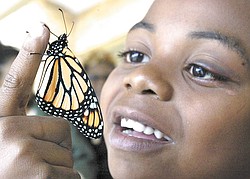
Donovan Dorsey, a fi rst-grader at Jeff erson Elementary School in Warren, frees a butterfl y during a school assembly. Students released butterflies in memory of loved ones in their lives who have died, moved away or been incarcerated. Donovan freed his butterfly in memory of his cat Fluffy.
 Photo
Photo
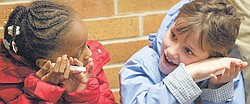
Saria Hurt, left, and Bryanna Criss hold butterfly boxes at the assembly.
 Photo
Photo
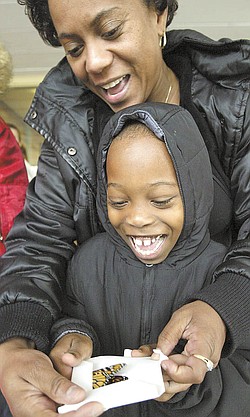
Isiah Hill, a second-grader at Jefferson Elementary School, Warren, and his mother, Alma Hill, get ready to release a butterfly at a school assembly.
 Photo
Photo
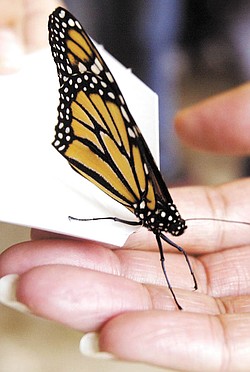
Students released butterflies during a Tuesday assembly.
By ED RUNYAN
WARREN
For some kids, it’s as simple as a dead kitty. For others, it’s the death or incarceration of a parent.
No matter what prompts a sense of loss in a child, they frequently need help in coping with it, said Suzanne Spirito, guidance counselor for kindergarten through fourth-grade students in the southwest area of Warren City Schools.
About a year ago, she approached the Raymond John Wean Foundation of Warren to see whether she could secure a grant to fund a program she called LOSS (Living WithOut Someone Special).
The Wean Foundation approved a $3,149 grant through its Neighborhood Success program, and the weekly sessions have been ongoing at the Jefferson K-2 building and Horace Mann Grades 3-5 building since the start of the school year.
On Tuesday, the 85 students celebrated by releasing a butterfly to symbolize the person they are missing.
Spirito read the following poem before the butterflies were released:
“As you release this butterfly in honor of me, know that I’m with you and will always be. Although you may a feel a bit torn apart, please know that I’ll be forever in your heart.”
At the Jefferson school, rain and cold conditions caused the butterflies to take their time before leaving the protection of their cardboard container. The butterflies did eventually flutter into the gray skies, but most gave their handlers time to touch them or hold them.
Kimberly Folmar explained later that her daughter, Cheyenne Folmar, a first-grader, was part of the program because Cheyenne’s great-grandmother died two years ago and her uncle died five years ago.
“She was close with her great-grandmother, because she lived with us in the same house when she died,” Kimberly said.
“My daughter used to have crying moments [over her great-grandmother’s death], but she’s better now,” Kimberly said.
One activity that had great impact was making a teddy bear with a heart representing her great-grandmother.
“She loses interest in a lot of stuffed animals, but she still has interest in that one,” Kimberly said of Cheyenne. “She sleeps with the bear, and I have to baby-sit the bear while she’s at school.”
Donovan Dorsey, a first-grader, said he misses his cat, Fluffy.
“He ran away, and a truck ran over it, and somebody threw it in the woods,” he said.
Nichole Bradford said she thought the program would benefit her second-grader, Destiny Simmons, after Destiny’s father experienced heart problems, which prevented her from seeing him for a while.
Destiny also missed her grandmother after she moved away four years ago.
Jennifer Roller, a Wean Foundation program officer, said the foundation liked Spirito’s proposal because it involved the parents and demonstrated that Roller “was really connecting with the community.”
“It was interesting in that it was so all-inclusive — death, incarceration, divorce,” Roller said.
Spirito said she was just responding to what she kept hearing from parents.
“Parents came in and said ‘Grandma died,’” Spirito said. In some cases, Spirito noticed that the child misbehaved for a while afterwards.
So she started asking parents to alert her when a child at her schools had experienced a death or loss.
“I figured it would be best to ask the parents instead of trying to guess and not knowing which other ones had also lost someone,” Spirito said.