 43
43

Parishioners weave palms into holiday crosses
By LINDA M. LINONIS
linonis@vindy.com
NEW MIDDLETOWN
 Photo
Photo
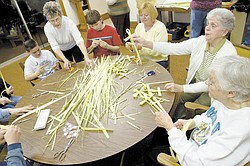
Volunteers, from left to right, Nicholas Workman, Fran Heinl, Adam Raub, Terri Raub, Kathy Finley and Twila Robb, make palm crosses at Zion Lutheran Church in New Middletown, Thursday evening on March 25, 2010.
 Photo
Photo
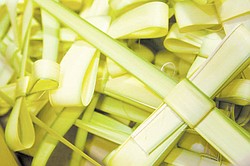
Palm crosses made at Zion Lutheran Church in New Middletown.
Zion Lutheran Church continues a tradition begun 27 years ago when Pastor Larry Klinker was new to the congregation.
Woven crosses from palms is a mainstay of the Palm Sunday service, which features a procession of the choir and children with palms in hand, and a reading of the Passion narrative. Straight palm buds and crosses are being distributed at services at 8 and 10:45 a.m. today.
Liturgical denominations such as Episcopal, Lutheran and Catholic use palms.
The palm crosses were crafted at a work session Thursday night by a small group of members at the church, 10857 Main St. Two people separated the individual buds or shafts from the fronds, bought at a florist. Pastor Klinker demonstrated how to weave the bud into a cross with a proper series of folds and bends.
Long-time church member Twila Robb aid she liked to make the crosses to share with other people. “I have to be retrained every year,” she said of the process.
Kathy Finley, a 12-year church member, appreciated “the fellowship” of the cross makers. Her retraining went quickly, and she had the process “down pat.”
First-timer Dan Beraduce, who came with his mother-in-law, Gail Holquist, a member since 1965, said it was a nice way to spend an evening. “It’s easy to do after a while,” he said of the cross-making process. Holquist also said she liked seeing the children in the palm procession.
Church secretary Fran Heinl, a member since 1962, said she liked the idea of “sharing something I made with my church family.”
“Given a choice of straight palms or crosses, people generally take crosses,” Pastor Klinker said. He said he got the idea from a book of faith-related activities.
“People like the tangible item to take home,” he said, adding that it reminded them of the account of Jesus riding into Jerusalem and of the Passion story presented in church.
Though that palm story is well-known, the Bible also has other mention of the use of palms. A reference in 1Maccabees 13:49-52 is about enemy troops in the Jerusalem fortress and how Simon brought about a peace and then led his soldiers into the fortress carrying palm branches.
In 2Maccabees 10:1-8, Judas Maccabee led troops to recapture the temple, which then was rededicated with people holding palm branches and thanking God for making the temple fit again for worship.
In the Maccabees references, palms are part of military victories.
Pastor Klinker said Jesus coming into Jerusalem, having palms and branches laid at his feet, then being called a king was misinterpreted by the people of the day. “He rode a donkey, a sign of peace,” Pastor Klinker said of the symbolism, noting if Jesus were a worldly king, he would have ridden a horse.
Though Jesus was called a king, it was of a spiritual kingdom.