 43
43

Mayor expects good news from feds
 Photo
Photo
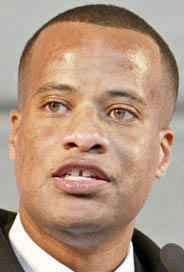
Youngstown Mayor Jay Williams
By DAVID SKOLNICK
skolnick@vindy.com
YOUNGSTOWN
After meeting with high-level federal officials, Youngstown Mayor Jay Williams said he expects a major announcement in April or May about federal funding or policy changes that will greatly benefit the city.
Williams led a group from Youngstown that met Thursday in Washington, D.C., with officials from the U.S. departments of Housing and Urban Development, Labor, Transportation, Agriculture, as well as the Environmental Protection Agency and the White House’s Office of Urban Affairs.
The meeting was convened by the Brookings Institution.
“I came away with the continuing and increased belief that these [talks] will result in federal government and national philanthropic investments” in Youngstown, Williams said.
The discussion centered on addressing the problem of vacant properties in neighborhoods, he said.
Work to take care of those problems could be assisted by money from the federal government and major philanthropic organizations and/or through policy changes that restrict how cities, such as Youngstown, can use federal money, Williams said.
Youngstown representatives discussed concerns they have about the use of federal money for demolitions.
HUD officials are concerned that too much money that goes to cities are used for demolition, Williams said.
But the mayor said he can show there is support in his city for more money to go toward demolishing vacant houses so land could be used for other purposes.
Others from Youngstown at Thursday’s meeting included: Bill D’Avignon, the city’s community development agency director; Jennifer Roller, program officer of urban affairs and neighborhoods for the Raymond John Wean Foundation; Presley Gillespie, executive director of the Youngstown Neighborhood Development Corp.; and Ian Beniston, the development corporation’s assistant director.
“It was a very productive meeting,” Beniston said. “We’re definitely on the national radar with the federal government and philanthropic organizations.”
The Youngstown group also brought up the need for the federal government to provide help to smaller industrial cities to staff their planning departments, Williams and Beniston said.
Officials from Detroit, Cleveland and Flint, Mich., participated in the discussions.
The four cities were chosen because of their dependence on the automotive industry.
But unlike the other three, Youngstown doesn’t have an automotive plant. General Motors has a plant in nearby Lordstown that is one of the area’s largest employers.
Also, unlike the other cities, the Valley GM plant is a success story.