 43
43

Justice for teens, by teens
By PETER H. MILLIKEN
milliken@vindy.com
YOUNGSTOWN
 Photo
Photo
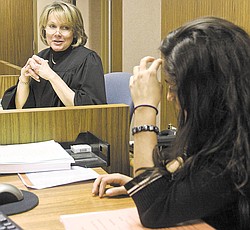
Judge Theresa Dellick of Mahoning County Juvenile Court presides over a teen court session with Grimilda Ocasio-Santiago serving as a student bailiff.
 Photo
Photo
Susan Buttle, youth court coordinator, guides the deliberations of teen jurors from area high schools at the Mahoning County Juvenile Court in the Martin P. Joyce Juvenile Justice Center on East Scott Street. After a defendant admits guilt, a jury of teen peers hears evidence, deliberates and renders a binding sentence. Ten other Ohio counties have teen courts.
A new teen court makes youthful offenders accountable to their peers and offers participants a hands-on learning experience on the justice system.
The program, designed for first-time juvenile misdemeanor and status offenders, was launched last month at the Mahoning County Juvenile Court in the Martin P. Joyce Juvenile Justice Center.
Ten other Ohio counties have teen courts.
It serves as a peer-sentencing court for cases such as shoplifting, disorderly conduct, harassment, truancy and fighting.
The court teaches participants about the law, the consequences of lawbreaking, conflict resolution, problem solving and due process.
“It’s a wonderful way for our youth to learn great skills in advocating, in public speaking, and in dealing with our own judicial system,” said Judge Theresa Dellick of juvenile court. “The juveniles who are involved in youth court who come before the teen court panel are less likely to re-offend.”
Teen volunteers must be high school students in good academic standing, who submit an application and teacher recommendation and undergo training before serving in the court. Volunteers rotate through assignments as prosecuting and defense lawyers, clerks, bailiffs and jurors.
After the defendant admits guilt, a jury of teen peers hears evidence, deliberates and renders a binding sentence. A sentence could be a written apology, community service, essays, finding employment, financial restitution or a curfew.
The teen jury cannot sentence a defendant to jail or a detention facility, however.
In a Tuesday session, Judge Dellick served as the judge, and the jurors came from a variety of high schools in Youngstown and its suburbs.
One of the hearings was a follow-up session concerning a learning-disabled fifth-grade girl who earlier had been sentenced to write a letter of apology to two retail stores from which she shoplifted, tour the juvenile detention center and improve her performance at school.
Since the shoplifting incident, the girl took the tour and wrote the letters.
She admitted, however, she was suspended from school two days for stomping her feet in study hall and five days for setting off a fire alarm, although she said she set it off accidentally.
When a juror asked her for her impression of the detention center, she replied, “Scared.”
“Would you like to be up there?” another juror asked.
“No,” the defendant replied.
“What do think you can do so you don’t end up there?” asked another juror.
“Straighten up,” the defendant replied as she sat next to her mother in the courtroom.
Rather than putting the case on the official court docket, which could lead to up to 90 days in detention, the jurors decided to sentence the defendant to undergo counseling.
“I want to be a lawyer when I get older, and this is a good steppingstone to make connections, and it’ll look good on my résumé,” said Abbey Christopher, 18, of Poland, a senior at Cardinal Mooney High School, who served as a juror.
The teen court program is “another diversionary tool” which decreases the number of official case filings in the court and teaches defendants a valuable lesson without the stigma of a formal filing, said Anthony D’Apolito, court administrator and magistrate.
Teen court sessions take place after school on the second and fourth Tuesdays of each month. Judge Dellick said establishing the program has not required any increase in the juvenile court’s budget.