 43
43

Lifting spirits
By ELISE McKEOWN SKOLNICK
news@vindy.com
EAST PALESTINE
 Photo
Photo
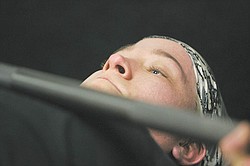
Chelsi Figley grimaces as she practices the bench press. The 27-year-old East Palestine resident, who is afflicted with spina bifi da, will compete in the Paralympic Games in Malaysia later this year.
 Photo
Photo
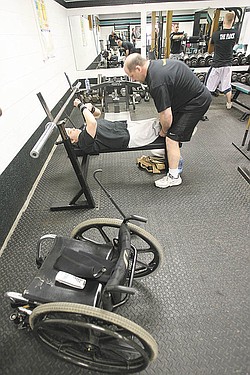
Chelsi Figley’s personal trainer Brian Raneri does more than provide workout motivation. He also helps the Paralympian weightlifter move from her wheelchair into position on the bench.
 Photo
Photo
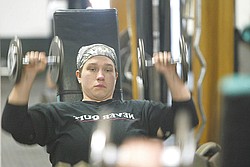
Chelsi Figley grimaces as she practices the bench press. The 27-year-old East Palestine resident, who is afflicted with spina bifida, will compete in the Paralympic Games in Malaysia later this year.
Many people exercise to lose weight. And Chelsi Figley is no exception.
Figley started lifting weights for just that reason. Little did she know she’d find her passion – and that it would take her to the powerlifting world championships in Malaysia.
Figley, 27, was born with spina bifida, a birth defect that causes partial paralysis. Because of it, she’s never had the use of her legs. That hasn’t stopped her from doing most of what she’s wanted though.
And becoming a power-lifter is one of those things.
Living in small-town East Palestine has meant there’s been little in the way of wheelchair options for Figley. Bigger cities often offer wheelchair basketball teams, gyms with wheelchair-accessible equipment and similar choices.
“I think in a way I’m grateful,” Figley said, “because I found out a lot more capabilities that I had because there weren’t the adaptations. So I had to figure out a way to do things.”
The Paralympic games weren’t televised, so, as a child, Figley watched the Olympic games instead. She found herself particularly intrigued by the gymnasts, especially those who participated on the uneven bars, the pommel horse and the rings – events focused on upper body movement.
“I have always wanted to be in the Olympics somehow, but I just didn’t know what to do or how to do it or how to get involved or anything,” she said. “Or even really what I’d be good at.”
Two years ago, she found that power-lifting was her event. She’s good at it, and she enjoys it, she said.
Figley bench-pressed 159 pounds at a championship meet in Virginia in June. That qualified her for the U.S. Paralympics Powerlifting Team that will compete at the 2010 International Paralympic Committee Powerlifting World Championships July 25-31 in Kuala Lumpur, Malaysia. She competes in the 114- to 123-pound weight class.
For Figley, this is just one step toward her goal: the 2012 Paralympic Games in London, England.
Her best weight-room bench press is 190 pounds, but Figley said she’s never done that much in competition.
Competitors must lower the bar to their chest, hold it motionless and then press it upwards to arms-length with locked elbows. They compete in 10 categories based on weight. Each has three attempts. The winner is the athlete who lifts the most weight.
Power-lifting isn’t all fun and games for Figley, though. On Sunday, Monday, Wednesday and Friday, she lifts weights for an hour. On Thursday and Saturday, she performs 30 to 45 minutes of cardiovascular exercise. Her trainer, Brian Raneri, stretches her every day for 20 minutes.
Plus, she needs to get enough sleep and watch what she eats.
She and her trainer are constantly tweaking her fitness plan.
But she keeps her eye on the prize. When she doesn’t feel like getting up at 5 a.m. for breakfast or doesn’t want to weigh her meat or cook her food for the next day, she asks herself how badly she wants to make it to the Paralympic Games.
“It’s very easy to break out of the habit,” she noted.
On top of training, Figley is attending school to become a medical biller and coder. Her classes are three and one-half hours every Tuesday and Thursday night.
She credits Raneri for much of her powerlifting success.
“His job is much harder than mine,” she said. “I just do what he tells me to do. He goes above and beyond.”
Since she can’t use her legs, she needs help with some things that are part of her workouts.
She can bench press 190 pounds, for example, but can’t get a 45-pound weight plate off the floor to take it across the room and put it on the bar, since she doesn’t have the power of her legs to get her back up from the floor.
For Figley, who’s never left the United States, the trip to Malaysia is a big deal.
“I’ve always had a difficult time whenever I travel,” Figley said. “Just because I don’t know what I’m going to be able to reach when I get there, and I don’t know how much help I’m going to need and I don’t like that.”
But she’s excited and honored to be going, she added. She’s also looking forward to meeting other athletes who are participating in the championships.
Because the trip is expensive, she needs to fund her own way. Her family and trainer will not travel with her. She’ll meet up with the other seven members of the U.S. team and they’ll fly to Malaysia together.
“I hope to leave [Malaysia] with a good lift of a personal record,” Figley said.
To follow Figley’s progress, or to sponsor her trip, go to http://chelsi2012.ucoz.com/index/meet_chelsi/0-4.