 43
43

Farmer’s request is denied
 Photo
Photo
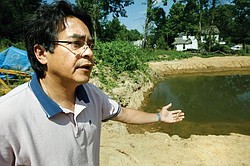
SHRIMPING: Ron Eiselstein of Youngstown gestures toward the pond on the city’s far East Side where he is growing Malaysian prawn, which are freshwater shrimp. In his hand he is holding a shell or skin the prawn leaves behind when it molts.
By PETER H. MILLIKEN
YOUNGSTOWN
Magistrate Dominic DeLaurentis has denied Ronald S. Eiselstein’s request for a preliminary injunction to keep the city from interfering with Eiselstein’s shrimp farm on the city’s East Side.
After the city’s lawyers moved to dismiss the injunction request, the Mahoning County Common Pleas Court magistrate ruled Monday that Eiselstein did not meet the requirements for an injunction.
Eiselstein sought the injunction after he pleaded innocent May 24 in municipal court to a minor misdemeanor citation for failure to obtain a zoning permit for his farm. His trial on that case is set for 4:30 p.m. June 14 in night court. If he’s convicted, the maximum penalty is a $100 fine and court costs.
City Prosecutor Jay Macejko said the city would now examine Eiselstein’s farm to determine whether it complies with the city’s zoning regulations and other ordinances.
The city’s position is that Eiselstein must cease operating the shrimp farm immediately, and the city will enforce that “either criminally or through the civil nuisance-abatement regulations,” Macejko said.
Eiselstein started his shrimp farm last June by putting 3,000 juvenile shrimp into a quarter-acre pond he created off Karl Street, and he ordered 40,000 shrimp this year. In this climate, the shrimp growing season is June through September, limiting growers to one harvest annually.
Excavation of 4- to 6-foot-deep ponds for the shrimp farm has scarred the land and caused erosion, complained Anthony Farris, the deputy city law director who moved to dismiss the injunction request.
But Eiselstein has previously said that he is being advised by top aquaculture experts and hasn’t damaged the land and that his land is zoned residential with agriculture as a permitted use.
After court, Eiselstein’s lawyer, Alden Chevlen, said he asked Charles Shasho, the city’s deputy director of public works, to provide a clear list of what Eiselstein needs to provide to city officials to make a shrimp-farming plan approvable; and Shasho agreed to provide that list in writing.
“Our plan is to cooperate with the city, provided the city gets some definition of what they want,” Chevlen said. “We have never had in writing a list of what the requirements are,” he added.
Under Ohio law, magistrates use a four-pronged test in deciding whether to grant an injunction: weighing the likelihood the plaintiff will prevail on the merits of the case, whether granting it will prevent irreparable harm to the plaintiff, what injury would be caused to others by granting it, and whether the injunction would serve the public interest.