 43
43

Cobalt sales continue climb
STAFF/WIRE Report
LORDSTOWN
 Photo
Photo
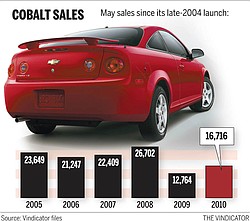
Sales of the Chevrolet Cobalt, built at the General Motors complex here, continued to increase last month, rising significantly from last year’s May sales.
Cobalt sales rose 31 percent to 16,716, up 31 percent from 12,764 cars sold in May 2009.
“It is a good car,” said Jim Graham, president of UAW 1112, which represents Lordstown’s assembly plant workers. “Gas prices are higher, and some of the competition is losing its luster.”
Rebates and incentives on the Cobalt, as well as the community’s improved outlook on the economy, have helped drive sales, said Bobby Stackhouse, general manager at Sweeney Chevrolet in Niles.
“We have doubled production from a year ago,” Stackhouse said. “Not only in the Cobalt, but in all of our cars we are seeing an increase.”
The Cobalt always has been a quality product, and the team at Lordstown has been proud to build it over the past six years, said Tom Mock, spokesman for the Lordstown Complex.
Cobalt production ends later this month, and the complex will launch production of the Cruze in late July.
GM’s overall sales rose 17 percent, led by an increase in sales of its four remaining brands — Chevrolet, Buick, GMC and Cadillac. Those brands got a lift from strong new products, such as the Chevrolet Equinox midsize crossover, Chevrolet Camaro muscle car, and Buick LaCrosse sedan.
Fleet sales spiked to 38 percent of GM’s sales. Those sales can hurt resale values and brand image, but the company said it expects to end the year with 25 percent of its sales to fleets.
“GM is not back 100 percent, but we are definitely on the right path,” said David Green, president of UAW Local 1714, which represents workers in Lordstown’s fabrication plant. “GM has spent a considerable amount of time, effort and money in their new products.”
Green said he expects GM to continue to post profits throughout this year.
Across the country, drivers snapped up new models, and rental-car companies and governments expanded their fleets in May, leading to big U.S. sales gains for most automakers.
The exception was Toyota, whose tepid results showed that the company’s discounts are losing their luster.
The industry’s overall jump in sales shows that automakers are benefiting from a fragile but improving economy.
Credit is thawing for car loans, and gas prices are stable.
Consumers even shrugged off an 8 percent decline in the stock market last month.
Ford Motor Co. will boost production through the fall, a sign that it thinks shoppers will keep buying.
Other Detroit automakers Ford and Chrysler Group saw double-digit sales gains over the same month last year, when GM was headed into bankruptcy protection and Chrysler was already there.
Chrysler sales surged 33 percent in May, marking the first month in more than two years it sold more than 100,000 vehicles. Strong sales of its Jeep Wrangler, pickup trucks and minivans helped to drive the increase.
Ford’s sales rose 22 percent, boosted by strong demand for the F-Series pickup and new Ford Mustang. Sales to rental, government and commercial fleets rose 32 percent.
But sales fell at Ford’s Lincoln, Volvo and Mercury brands, with Mercury down 11 percent. The company will phase out the Mercury brand. Ford brand sales climbed 28 percent.
Ford said its inventories have fallen to a 48-day supply; a 60-day supply is the standard. U.S. sales analyst George Pipas said Ford is increasing second-quarter production by 15,000 vehicles to 640,000 cars and trucks. That would make second-quarter production 42 percent higher than a year ago. Ford also anticipates it will raise third-quarter production.
Ford said it will end the year with about 30 percent of its sales to fleets.
Several Japanese, South Korean and European car makers also saw increases of 20 percent or more.
If the trend holds for most automakers, May would be the seventh-straight month of year-over-year sales increases for the industry.
But consumers backed away from Toyota Motor Co., whose sales rose just 7 percent over last May, even though the company said Memorial Day was its best-selling weekend of the year.
Toyota has been using big incentives since March to drum up sales after it recalled millions of cars and trucks for safety problems.
The outlook for auto sales through the summer appears rosy — provided the economy cooperates.
The financial markets need to stabilize and employers need to start hiring at a faster clip for sales to continue climbing, said Paul Ballew, a former chief economist at GM who is now chief economist at insurance firm Nationwide.
But several trends bode well for new car sales. Prices for used cars have been rising, which means consumers on the fence between a used and new car are more likely to buy new, Taylor said.
In addition, gas prices remain steady, home prices have started to stabilize and consumers are becoming more eager to replace their aging vehicles, he added.
Copyright 2010 Associated Press. All rights reserved. This material may not be published, broadcast, rewritten, or redistributed.