 43
43

Preparation is key to staying safe
 Photo
Photo
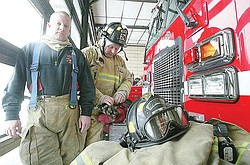
GEARING UP: Girard firefighters Jay Barnhart, left, and Nathan Walker III suit up in their regular gear, which is worn year-round. The headgear includes a hood of Nomex, a registered trademark for flame-resistant material. Firefighters said they sometimes wear thermal underclothes when outside temperatures are low.
 Photo
Photo
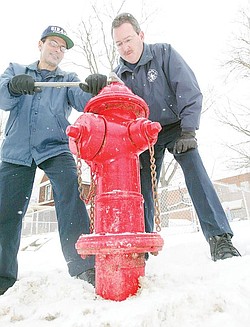
SNOW JOB: Girard Fire Capt. Salvatore “Sal” Ponzio, left, shows how a wrench is used to access a fire hydrant as firefighter Jim Quinn lends a hand. Girard water department maintains the hydrants and citizens cooperate by reporting any problems. If a hydrant should freeze, fire trucks carry 2,000 feet of hose to reach other hydrants and also carry a water supply.
Common sense, advance planning and safety measures save lives.
Common sense and preparation can help keep people from becoming a fire statistic, according to Girard Fire Chief Ken Bornemiss.
The state fire marshal’s Web site, www.com.ohio.gov/fire, reported nine fire fatalities as of Jan. 5. There were 149 in 2009 and 188 in 2008.
“Many of these people had working smoke detectors,” Bornemiss said of fire-related deaths. But, he pointed out, they either didn’t leave the structure as soon as they were aware of the fire, or they went back in to rescue a pet or retrieve something.
“Get out and stay out,” was the advice from Bornemiss. “People usually think the fire is small and they can handle it. They’re shocked at how fast it accelerates.”
When you and your family are out of the house, call 911.
Common sense and preventive measures save lives when fire strikes.
Bornemiss also advised people to arrange a meeting place near their residences where they will gather in an emergency. This allows families to take a head count and know who is out of the house. If someone is missing, they can inform firefighters.
“We’re good at what we do because we practice,” Bornemiss said, noting that families should practice their own fire drills and meet at the designated place.
“Develop an evacuation plan. Find two ways to get out of every room,” he said.
The chief said that though some people may think drills aren’t necessary, they help residents think ahead in the event of an emergency and reinforce where exits are even if they’re obscured by smoke.
Winter and its low temperatures, howling winds and snow create situations for potential fire hazards.
Capt. Salvatore “Sal” Ponzio said candles are one hazard. “People forget about them and leave them unattended.”
He and the chief also noted that scented candles are popular and contain perfume oil. “The candle burns down, and the oil spills and catches on fire,” Ponzio said.
Space heaters present another issue. Bornemiss said many turn off automatically so they don’t overheat, but others don’t have that safety feature. “They radiate heat, so place them at least three feet or more away from yourself, bedding and draperies,” he said.
Fireplaces and wood-burning stoves may add ambience to your home, but they can be potential hazards. For both, the firefighters advised, make sure they’re in working order before they’re put in use. As for fireplaces, have them checked by a professional for buildup of creosote, a carbon material that accumulates in chimneys from wood-burning fires.
A year-round problem is people cooking, then leaving the stove unattended. “People fall asleep all the time,” Ponzio said, then wake up to a kitchen fire.
Bornemiss also cautioned people to be careful when they’re reaching into cabinets above and near the stove where clothing can come into contact with hot burners and ignite.
If you do get burned, call 911 immediately. “You can put a damp, clean cloth on the burn,” Bornemiss said. Do not use butter or ointment.
Bornemiss and Ponzio advised people to have working smoke detectors and fire extinguishers in their homes. “Check them once a month if you can and at least twice a year when the time changes, “ Bornemiss said. “Get all-purpose, five- to eight-pound extinguishers,” Bornemiss said. The kitchen is the best place to store the extinguishers. The chief said the department offers advice on where to place detectors and will help people get them installed.
Ponzio said another cold-weather hazard is people starting their cars in attached garages with the doors closed. “There’s a buildup of carbon monoxide, and their detectors go off, and they don’t know why,” he said.
The department also responds to calls about sled-riding accidents and when someone has fallen through ice on a body of water. The department has boat and trained divers.
Chief Ken Bornemiss leads Girard Fire Department, 105 E. Liberty St., which has a staff of three captains and nine firefighters. Eleven are emergency medical technician paramedics and two are EMT basic. The department responded to 900 calls in 2009 including 395 emergency medical service calls, 20 structure fires, 10 vehicle fires, a variety of other fire calls and a host of miscellaneous calls for help. It has two engine trucks, one ladder truck, 1 rescue truck with the Jaws of Life and a rescue boat. The non-emergency number is (330) 545-0318.
Teamwork: Jerome Lambert, director of public services, and Ken Moran, street supervisor, said the departments work as a team to ensure that the fire department gets to its destination and fire hydrants are in working order. Moran said he and Bornemiss worked out an emergency plan when there is multiple inches of snow. Main streets that would be used by the fire department to get to calls are a priority. The driveway out of the station also is kept clear so the trucks can get out safely and quickly. Girard has about 70 miles of roads.
Hydrants: On the fire department’s map, there are 328 hydrants in the city maintained by the water department. Lambert said a maintenance program checks to make sure they’re in working order and many have been newly painted. He said more than 50 were replaced last year. “Citizens let us know if a hydrant is leaking or they see a problem,” Lambert said, adding there is “good cooperation” with residents. The sides of streets with hydrants has no parking. Hydrants may freeze in winter but each fire truck has 2,000 feet of hose to reach hydrants and trucks carry a water supply.
Safety tips for fireplaces and wood stoves: Allow clearance between a stove and combustible materials such as walls, floors and ceilings; place stove on approved board to protect floor; make sure the flue is open before lighting a fire and never close flue while a fire is smoldering; use a fireplace screen; never use gas or lighter fluid to start a fire; when lighting a gas fireplace, strike match first then turn on gas.
Portable space heaters: When buying a heater, check for automatic shut-off; never leave a heater unattended; don’t use an extension cord with heater; and never use heaters near water; fill heater with only crystal clear K-1 kerosene and never use a fluid that is not recommended.
Smoke detectors: Install a detector on every level and inside each sleeping area; test detectors monthly; vacuum dust from inside the detector annually; change batteries twice a year; and replace every 10 years.
Source: Girard officials and safety tips from Division of a State Fire Marshal