 43
43

Austintown police officers attend autism training
 Photo
Photo
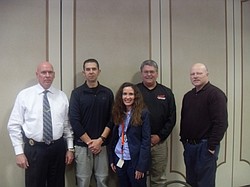
Neighbors | Submitted .Six police officers from Mahoning County attended an autism risk management and safety course on Feb. 3. From left, Captain Bryan Kloss of the Austintown Police Department, Lieutenant David McKnight of the Youngstown Police Department, Detective Michelle Glaros of the Boardman Police Department, Patrolman Jerry Fulmer of the Youngstown Police Department and Officer Brian Hartman of the Beaver Township Police Department. Scott Bennett of the Canfield Police Department is not pictured here.
By GRACE WYLER
gwyler@vindy.com
The Austintown Police Department will now incorporate autism risk management and safety into its monthly training program, according to Captain Bryan Kloss.
Police officers from five towns in Mahoning County, including Kloss, attended an autism safety training course in Independence on Feb. 3. Following the seminar, Kloss was granted permission to purchase an autism training DVD and incorporate the program into the department’s officer training. He will also purchase a second training DVD for the Fire Department.
“The training was excellent,” Kloss said. “It raised my awareness about how to respond to and interact with people with autism.”
The training course, sponsored by the Greater Cleveland Chapter of the Autism Society of America, was led by Dennis Debbaudt.
Debbaudt, who has a 26-year-old son with autism, trains first responders — including emergency medical technicians and law enforcement officers — in recognizing and responding to calls involving people with autism disorders.
At the urging of Andrea Keller, the mother of a 14-year-old boy with autism, State Senator Joe Schiavoni, sent a letter to police departments in the 33rd district encouraging officers to attend the free training session.
Diagnoses of autism, a neurological disability that affects people with varying degrees of severity, have dramatically increased in the past decade, Keller, a Canfield resident, said. One in 100 children are diagnosed with autism, she said.
Police officers do not have any formal training in how to identify and react to people with autism, Keller said.
“My hope is that we will make this not optional training but more standard training, especially with patrolmen,” Keller said.
Schiavoni said he was excited to see that officers from Youngstown, Austintown, Beaver, Boardman and Canfield attended the training program.
“I think that this shows that the police officers in Mahoning County, and in our area in general, really care about the people that they serve,” he said.
The training session included discussion and videos about communicating with people with autism, possible problems with interrogation and interviews and restraint and arrest options.
“In the training, everyone learned the value of calming body language, giving people extra time to respond and using clear language if at all possible,” Debbaudt said. “It is all based on officer safety but the key is to remember that these calls are going to take longer.”
Debbaudt, who has conducted autism risk management training with first responders for 15 years, has written over 30 book chapters and reports addressing interactions between law enforcement and people with autism.
Debbaudt has also done consulting and provided training materials for large law enforcement agencies, including the Department of Homeland Security, the Pennsylvania State Police, the New York Police Department and police departments in Toledo and Cincinnati.
“In different parts of the country, this training is really catching on,” Debbaudt said. “At the training, by mere show of hands, it was pretty much unanimous that this type of training would be very useful in the state of Ohio.”