 43
43

Petraeus operates on hope
ASSOCIATED PRESS
 Photo
Photo
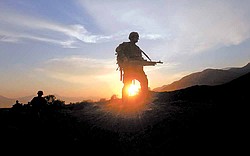
U.S soldiers of 2nd Platoon Bravo Company 2-327 patrols as sunset in Chowkay district of Kunar province in eastern Afghanistan near Pakistan border on Sunday, Dec 26, 2010.
KABUL, Afghanistan
As President Barck Obama was rolling out his Afghan policy review, I had the chance to visit U.S. forward-operating bases in the Taliban heartland and to interview Gen. David Petraeus.
I came away convinced that, after the surge of 30,000 U.S. troops, real progress is being made in clearing the Taliban from large areas in the south — and disrupting its networks. Yet a visit to Camp Hansen, a dusty U.S. outpost in hotly contested Helmand province, made clear why Obama called those gains “fragile” and said they could be reversed.
U.S. troops hope to expand and link “ink spots” — areas cleared of Taliban — in rural Helmand districts such as Nawa and Marjah. The U.S. military wants to transition partial responsibility for Nawa to Afghan civilian and military personnel by next summer.
But that goal is undercut by two factors. First, the central Afghan government in Kabul hasn’t sent personnel to staff local and district offices — or to dispense justice. The failure to adjudicate land disputes pushes farmers into the arms of the Taliban, which operates religious courts. Moreover, the central government often appoints corrupt provincial and district governors or tries to fire honest ones. It took heavy NATO pressure to keep the capable governor in Helmand from being fired by President Hamid Karzai.
Pakistan
Second, when the Taliban is driven out of Helmand, it can find sanctuary across the border in Pakistan. Marine Col. David Furness told reporters that the Taliban brought in weapons and electronic components along the “rat line” from Pakistan. “If they couldn’t go to Pakistan, it would be over,” he said.
As commander in Afghanistan, Petraeus is painfully aware of these two strategic Achilles heels: lack of adequate governance and the safe havens in Pakistan. At his headquarters in Kabul, he spoke of military gains, saying U.S. forces have “arrested the momentum of the Taliban in many areas and reversed it in some,” while taking out midlevel Taliban members and bomb-makers.
Handing out copies of his famous multicolored PowerPoint charts, he described a strategy that, while focused on the south and east, is also doing “shaping operations” in the troubled north and expanding the vastly improved security in Kabul to its neighboring provinces.
He was clearly piqued that many think his focus is now purely military, and he stressed that “kinetic operations, while necessary, are not sufficient.” While securing an area is the priority, he said, “you have to exploit it through Afghan local governance and anticorruption measures” so villagers “will support the Afghan government.” In other words, if their local government doesn’t offer services and justice, the people will turn, often reluctantly, to the Taliban.
Petraeus has not given up hope that nascent Afghan institutions and government will gradually improve. “The governors (Karzai) has appointed on my watch have been generally impressive,” the general said, and more civil servants are being trained to take jobs in far-flung districts. Petraeus has a team pursuing cases of Afghan corruption (including those fueled by lucrative U.S. contracts), and he says Karzai is cooperating.
President’s brother
However, the general does not want to discuss the issue of Karzai’s brother, Ahmed Wali, a powerful and controversial figure in Kandahar, whose machinations are blamed by many for tribal divisions that create openings for the Taliban.
Petraeus appears to be hoping that security gains will create a virtuous circle: As the economy picks up, villagers will turn against the Taliban, and Karzai may want to win their approval by performing better. Those gains may also affect Pakistan’s attitude toward giving the Taliban safe havens.
If Afghanistan seems more secure, and the Taliban has little prospect of retaking power in Kabul, Pakistan may reassess its value as a future card in its conflict with India.
Petraeus says he is neither “an optimist or a pessimist.” Instead, he repeats Obama’s mantra that Afghan progress is “fragile and reversible” and “must be solidified.”
David Petraeus knows Afghanistan is much tougher than Iraq, and that the burden falls most heavily on his shoulders. I sense that he thinks success is possible, but he isn’t sure.
Trudy Rubin is a columnist and editorial-board member for the Philadelphia Inquirer. Distributed by McClatchy-Tribune Information Services.
Copyright 2010 Associated Press. All rights reserved. This material may not be published, broadcast, rewritten, or redistributed.