 43
43

Choffin surgical tech program garners national accreditation
 Photo
Photo
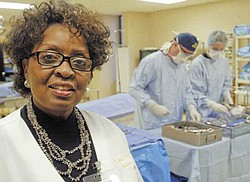
Carole DuBose, program coordinator of surgical technology at Choffin Career and Technical Center, explains the program that recently earned national accreditation through 2020 by the Commission on Accreditation of Allied Health Education Programs.
 Photo
Photo
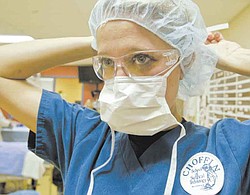
Katie Ann Guarino of Warren prepares for a class surgical procedure. She is a student in the surgical-technology program.
By Denise Dick
YOUNGSTOWN
From the fundamentals of surgical instruments to the ins and outs of surgical procedures, students in Choffin Career and Technical Center’s surgical-technology program prepare for the operating room.
The adult program recently was awarded national accreditation through 2020 by the Commission on Accreditation of Allied Health Education Programs.
“A surgical technologist is the right hand of the surgeon,” said Carole DuBose, program coordinator.
He or she sets up all the instruments needed for surgery, handing them to the surgeon when needed.
That means they have to know the steps of the procedures, too.
“They have to be able to anticipate what the surgeon needs,” DuBose said.
The program includes 12 students this year. After completing the coursework, they must pass a test for certification. Choffin’s program has an 80 percent to 85 percent passage rate, the coordinator said.
“I want to complete the program and get a job as a surgical technologist,” said John Boyer of Masury, one of the students in the course.
Boyer works in silk screening and graphics but formerly had a job in the medical field. He decided that’s the career he wanted to pursue.
Suzanna Ellis of Cortland used to work as a corrections officer, but after getting laid off twice, she opted for another field.
She completed Choffin’s program in phlebotomy — drawing blood — and decided to move on to surgical tech.
“I tell my students, ‘You can make a nice living as a surgical technologist or you can use it as a steppingstone to another profession,’” DuBose said.
Students have gone on to be registered nurses, such as Teresa Colon, who secured that degree after completing the surgical-tech program. She now works as a clinical instructor in the program.
Another works on an organ-procurement team, DuBose said. Some become physician assistants, work in surgical sales or teach.
“It’s an accelerated program,” DuBose said.
Both Boyer and Ellis attest to the intensity.
“It’s usually a two-year program, and we do it in 10 months,” Ellis said.
Students spend time working in clinics at both Forum Health and Humility of Mary hospitals in the Mahoning Valley.
One of the first things emphasized in the program is the importance of achieving and maintaining a sterile surgical environment.
Students learn how to put on sterile robes and gloves and the importance of goggles.
DuBose is a stickler about it, and she believes it’s one of the reasons that employers calling her when they have an opening for a surgical technologist.