 43
43

Villa Maria Farm continues tradition of helping the needy
 Photo
Photo
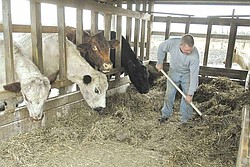
Richard Graney tends to cattle on Villa Farm, where White Parks, shorthorn and a black Angus mix graze in the fields. The farm has a small sheep herd. Sisters of the Humility of Mary lived off the land when they arrived in the United States in 1864.
 Photo
Photo
The Market Barn at Villa Farm in Villa Maria, Pa., features seasonal produce, herbs and flowers. The farm donates 50 percent of its produce to help the needy, continuing a mission of the Sisters of the Humility of Mary.
 Photo
Photo
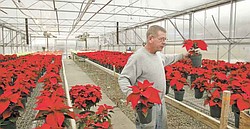
Richard Graney, who works in the land-management area at Villa Maria Farm, tends to poinsettias in the greenhouse on the grounds of Villa Maria Community Center in Villa Maria, Pa. The greenhouse, heated by a wood-burning furnace, produces seasonal flowers and plants and is part of the farm operation.
Villa Maria Farm is part of the Villa Maria Community Center Complex, Evergreen Road, Villa Maria, Pa. At Villa Maria, there also are natural gardens, an herb garden and nature trails.
Farm-based environmental
programs: Geared to pre-kindergarten through 10th grade, these programs provide hands-on learning that fosters an ethic of care for Earth. Experiences with farm animals, wildlife habitats, seeds, plants, composting,
recycling and seasonal outdoor activities introduce children to basics of ecology. The program is correlated with the Pennsylvania and Ohio Academic Standards.
G.R.O.W.: The Gardening Responsibility Once Weekly summer day camp is for children entering first through third grades. They learn about seeds, bugs, lambs, trees and soil as they plant and care for a garden, make friends with farm animals and grow in appreciation of the natural world.
Garden clubs: Area garden clubs are invited to have meetings at Villa Maria, enjoy lunch and a tour of the
diverse garden areas or attend a presentation on various topics such as garden spirituality, composting, herbs, organic gardening and updating for Master Gardeners.
Eco-spirituality: Spirituality, simplicity and sustainability shape programs for people of all ages, cultures and religions. Earth education and experiential activities rooted in the physical health of all creation are manifested in simplicity circles, nature and labyrinth walks and film and discussion series.
Contact information: 724-964-8920, ext. 3387. The Market Barn at the farm sells produce and seasonal flowers.
By LINDA M. LINONIS
VILLA MARIA, PA.
Villa MARIA Farm preserves the agricultural legacy that sustained the Sisters of the Humility of Mary when they came to the United States from France in 1864.
The order, founded by Marie-Antoinette Potier who became Mother Madelaine, was invited by Bishop Amadeus Rappe of Cleveland to serve French immigrants in the diocese. He provided a place in Pennsylvania for the motherhouse, now Villa Maria Community Center, on Evergreen Road. It’s off U.S. Route 422 East, one mile from the Ohio-Pennsylvania line.
John Moreira, director of land management at Villa Maria, said Villa Maria Farm covers 728 acres. “We farm 300 acres," he said. The other 400 acres or so are woodland and wetlands with wildlife and nature trails. Five acres are dedicated to an organic garden and 40 acres to the Audubon Wildlife Sanctuary.
“This is viable, living history,” Moreira said of the background of Villa Maria. “When the sisters came here, they lived off of the land. ... It sustained them.”
But it did more than feed the nuns. Produce, crops and farm animals also fed the needy. That tradition continues to this day.
Moreira said 50 percent of the produce is donated to church food pantries, St. Vincent de Paul Society’s soup kitchen on Front Street in Youngstown, Dorothy Day House for the homeless in Youngstown, Emmanuel Care Center in Girard, City Rescue Mission in New Castle, Pa., and the Pittsburgh Food Bank.
What the Villa Maria Farm raises and sells goes toward maintaining the overall operation. A greenhouse produces seasonal flowers and plants for sale to the public. This year, the greenhouse produced 1,100 red and white poinsettias and Monet, a reddish pink hybrid.
Moreira said many of the poinsettias are spoken for, having been ordered by churches. To buy poinsettias, call 724-964-8920, ext. 3385.
An array of other seasonal flowers burst into bloom in the greenhouse. They include Easter lilies, daffodils and hyacinths in the spring, hanging baskets and geraniums in the summer and chrysanthemums in the fall.
Moreira said the greenhouse also has potted herbs for sale in the spring.
Villa Maria Farm produces some 70 kinds of vegetables, which are organically grown. These are available at the Market Barn at Villa Maria Farm.
Villa Maria Farm also raises beef cattle and sheep. “The sheep are more symbolic ... after all, Jesus was a shepherd,” Moreira said. The seven sheep are Cheviot, Dorsett and Suffolk breeds.
The cattle, White Parks, shorthorn and a black Angus mix, also roam fields on the farm. “The Parks are an English heirloom breed,” Moreira said. Winston Churchill sent White Parks cattle to the United States during World War II to protect the breed. The Villa herd numbers between 35 and 50. “We grow our own grains for feed. There’s no antibiotics or steroids used,” Moreira said.
The animals aren’t pets at the farm; they are livestock. At the community center’s nativity display last weekend, a beef dinner was featured; this weekend’s feature will be a lamb dinner.
Moreira said Villa Maria Farm also is an educational environment. It provides “hands-on learning” for public and parochial student groups who participate in programs. “The kids who come here seem to develop a new work ethic ... and want to be part of the solution in the environment,” Moreira said.
Moreira said the farm also affects students on a spiritual level because of the tranquil and pastoral setting. “I’ve seen them turn around. ... It makes a difference in their lives.”